
Monday morning, the team chat announces a promotion. Ten minutes later there are twelve identical “Congrats!” replies under it, each with a different sticker. You wanted to write something with a bit more life in it, typed three drafts, deleted all three, and sent “Congrats!” so you wouldn't be late to the party.
In Vietnamese it gets harder, because the words for “you” and “I” change with every person. So I built Wishjar, a jar of Vietnamese wishes, pickup lines and captions. Pick who the message is for and the occasion, shake the jar, and you get a line with the pronouns already filled in correctly. It runs in the phone browser, with no install and no account.
Shake the jar, get a line for the right person
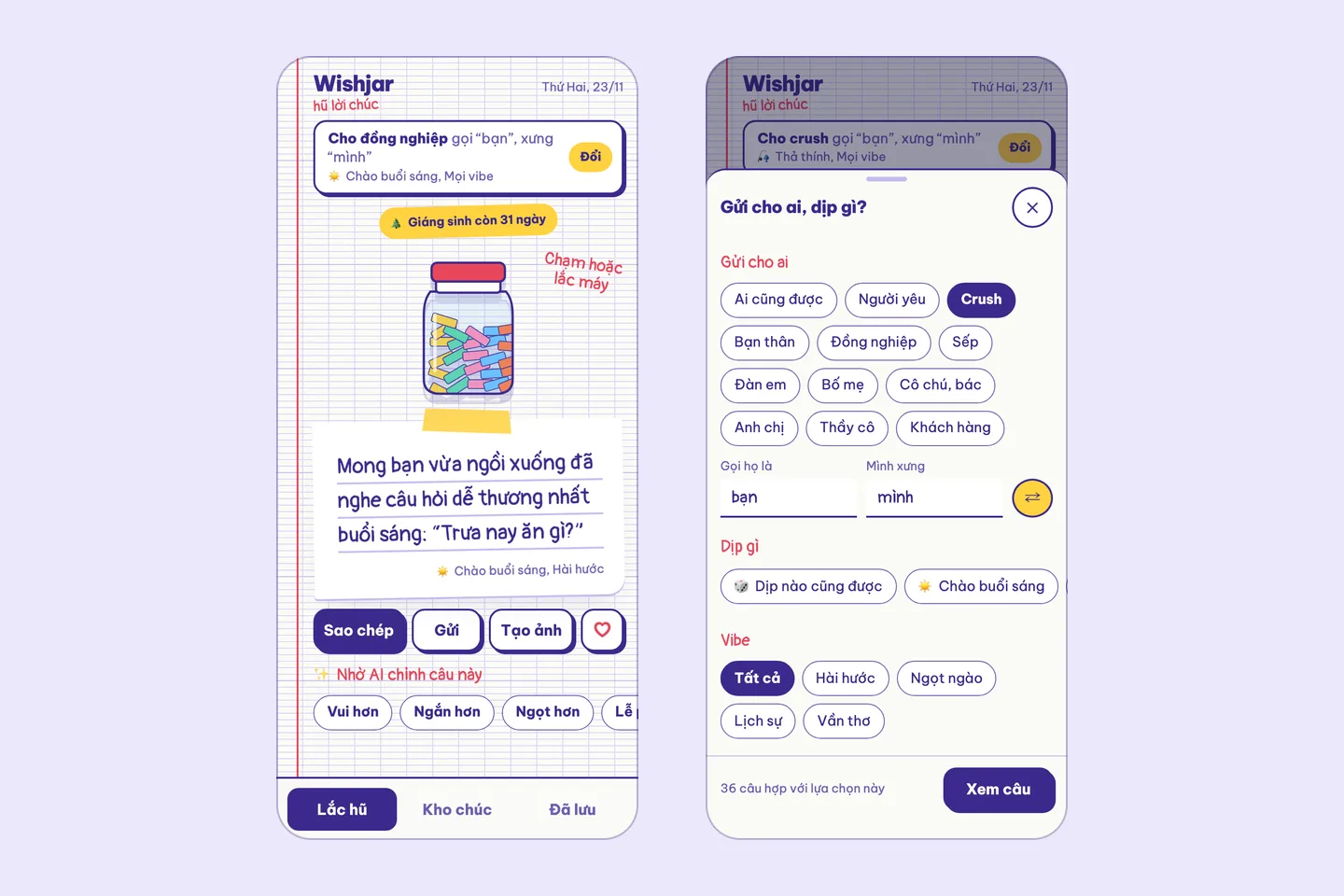
The home screen is a jar of paper strips sitting on a page of a Vietnamese school notebook. Tap the jar or shake the phone and a line drops out. The app opens on a “wish of the day” that stays the same all day; each shake then gives a new line you haven't just seen.
Tap Đổi (change) to set three things. Who it's for: a partner, a crush, a best friend, a colleague, your boss, a junior, your parents, older relatives, older siblings, a teacher or a client. Which occasion: 28 of them, from good morning, Monday blues, payday, flirting and making up to birthdays, promotions, weddings, Lunar New Year, Mid-Autumn and Teachers' Day. And the vibe: funny, sweet, polite or rhyming.
Give it 20 seconds: open Wishjar, pick “Đầu tuần” (Monday), shake a few times and send your favorite to a tired colleague. The lines are in Vietnamese, so this one works best if your colleague reads it.
A strip under the jar shows the holidays coming up, including the lunar ones like Tết and Mid-Autumn, and one tap switches to that occasion. On the day of a holiday the app opens on it; after 9 p.m. it suggests good night, and on Monday mornings it suggests a start-of-week line.
Why pronouns are the hard part
Vietnamese has no single word for “you”. You address people by age and relationship, then refer to yourself to match: “con” to your parents, “em” to an older colleague, “tớ” to a crush, “tao” only to a very close friend. A line written for a partner, sent to your boss, gets both the tone and the relationship wrong.
So every line in Wishjar has two slots, one for the recipient and one for the sender. Here is one real line from the library (it says: “However busy the week starts, remember to eat on time. I can't be there to keep reminding you, so this message stands guard for me”):
- To your parents: “Đầu tuần bận mấy cũng nhớ ăn đúng bữa nha. Con không ở cạnh nhắc hoài được nên gửi câu này đứng canh bố mẹ.”
- To your partner: “Đầu tuần bận mấy cũng nhớ ăn đúng bữa nha. Anh không ở cạnh nhắc hoài được nên gửi câu này đứng canh em.”
Each kind of recipient comes with the pair people use most. If your family says it differently, type your own, or tap the swap button to flip the pair. Lines that don't suit the chosen recipient never show up, so you won't shake out a pickup line while sending something to a teacher.
Send it, save it, ask the AI to tweak it
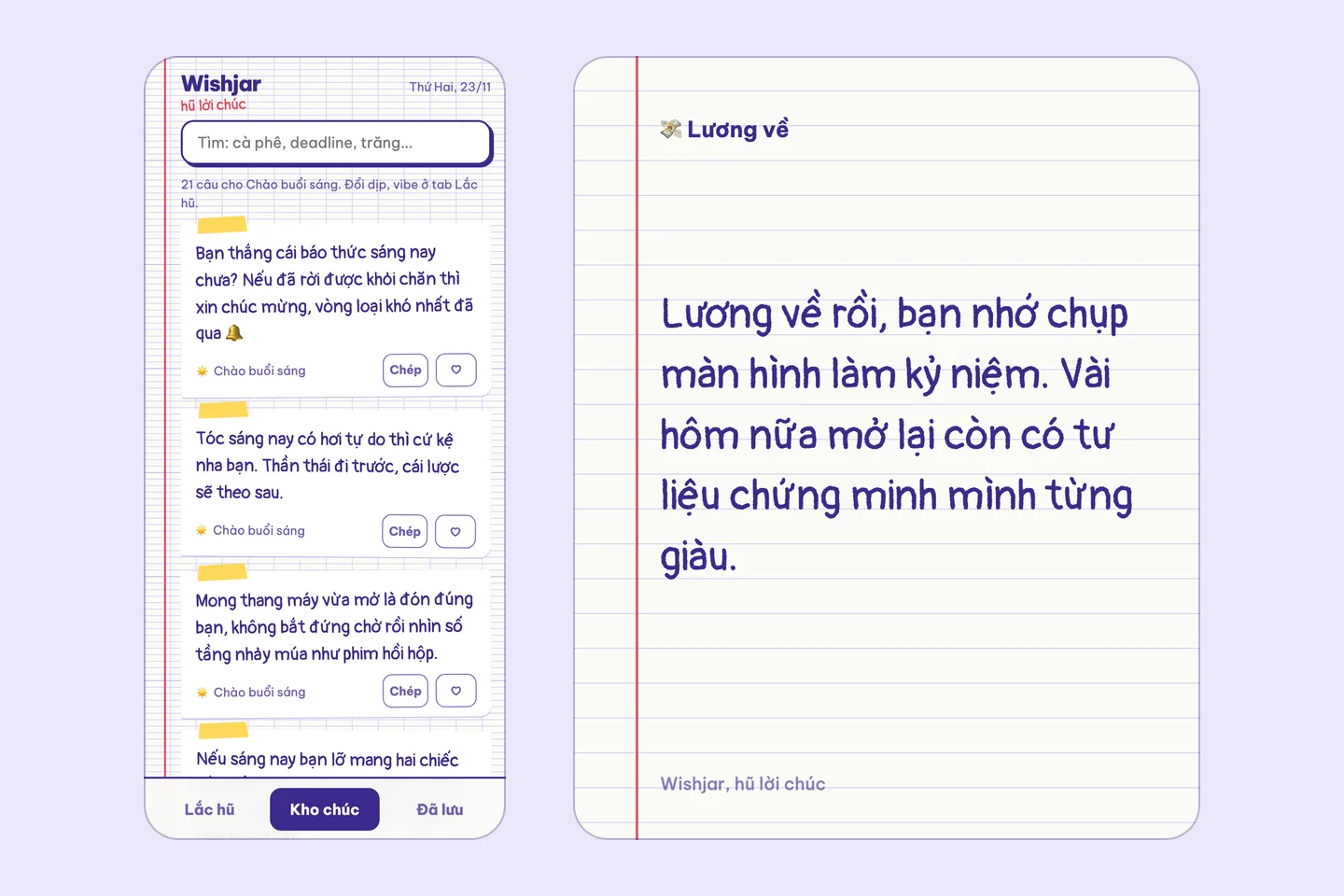
Once a line feels right, copy it, open the phone's share sheet to send it straight to Zalo or Messenger, or tap Tạo ảnh (make image) for a 1080×1350 notebook-page card that fits a story. The Kho chúc (library) tab searches every line, with or without Vietnamese accents. Heart a line and it moves to the Đã lưu (saved) tab, stored in your own browser.
When a line is close but not quite there, a row of AI buttons sits underneath: funnier, shorter, sweeter, more polite, or turn it into a poem. Each tap returns three rewrites to pick from. There's no chat box. The app sends only the line's id, the style and the recipient, so the AI only ever works on a line that already exists in the library. You get help from the AI without writing a prompt.
Wishjar is also a PWA: add it to the home screen and it opens like a normal app, and the jar still works offline because the whole library is already on the phone. Only the AI tweaks need a connection. To shake on an iPhone, Safari will ask for motion sensor permission on the first tap of the jar.
Where 1,008 lines come from
The library has 1,008 lines today, 36 per occasion. I wrote a voice guide: short sentences, everyday images, jokes that never turn crude, and none of the stock phrases every Vietnamese greeting card already has. Next to it sit a few sample lines, some current slang and a list of clichés to avoid. Codex CLI reads that guide and writes new lines against a fixed JSON schema.
Every generated line then goes through a script: the right pronoun slots, the right vibe, the right recipients, a sane length, and no near-duplicate of an existing line. Whatever passes, I still read one by one before committing. Codex is genuinely funny, but not always tactful, so I keep treating AI suggestions as a draft and the human read is not optional.
The lines the AI writes when someone taps a tweak button are kept too, with the original line and the style. Later I'll review the good ones and add them to the library for everyone.
Under the hood: static first, one paid path
If you don't build software, feel free to skip this part. Wishjar is Vite and plain TypeScript with no UI framework, about 73 KB gzip including the whole library. The server is a small node:http app with no web framework and one runtime dependency, the Anthropic SDK, running in Docker on a VPS behind a Cloudflare tunnel.
The only path that costs money is the AI tweak, which calls Claude Haiku from the server. That path has every lock I could think of: requests only from the site itself, a 1 KB body limit, daily limits per IP and per visitor, a global daily cap, and a 24-hour cache so tapping the same button again costs nothing. I drew the full architecture of Wishjar and Ăn Gì in C4, including the parts that aren't ready to scale, in Ăn Gì and Wishjar in the C4 model.
On personal data: there are no accounts, and saved lines stay in your browser. The app creates a visitor id in your browser and sends it only with AI tweak requests, to count the daily limit. The live version has analytics turned off. If I turn them on later, PostHog loads after the page is visible, respects Do Not Track and never records sessions.
What building Wishjar taught me
The biggest lesson was where to put the AI. Having it write a wish every time someone taps would be slow, costly and hard to check. Having it write ahead of time, with a script and a person checking, means users get a line instantly, I know exactly what's in the jar, and the AI at runtime does one small job: tweaking a line that already exists.
The second lesson sounds a little funny: the hard part of a Vietnamese wish app lives in tiny words like “anh”, “em”, “con” and “cháu”. When something small is easy to get wrong, make it structured data from day one instead of trusting every sentence to handle it.
Next time someone in your chat has a birthday, a promotion or a last day, open Wishjar before typing “Congrats!”. Shake a few times, pick the line that fits, fix the pronouns and send it. They'll notice you picked it for them.