
The side project often starts in a small, unpolished place. A notes file after work. A rough folder on the desktop. A local app that only solves one annoying problem. The first version may have no logo, no roadmap, and no audience beyond the person building it. Still, there is a quiet energy in that beginning. For once, the question is not what the ticket says. It is what would be useful enough to try.

Side projects matter because they create a low-pressure space to learn by making. At work, every change is connected to deadlines, stakeholders, review standards, legacy constraints, and customer impact. That is healthy and necessary. But it also means experimentation has a cost. A side project gives a smaller room where curiosity can move without asking a committee first. You can try a new framework, write a tiny compiler, build a family budget tool, automate a personal workflow, or design a page just to understand how it feels.
This does not mean everyone must spend their evenings coding. That idea turns learning into another form of pressure, and many people already give enough energy to work, family, health, study, and ordinary life. A side project is valuable only when it fits the season you are in. Sometimes the right side project is not an app. It is a reading list, a spreadsheet, a small habit tracker, a collection of notes, a prototype, or a few diagrams that help you think more clearly.
The strongest side projects often begin with a personal itch. You notice that you repeat the same calculation every month. You want a better way to review books. You want to understand how authentication works. You want to see whether an AI workflow can save one hour a week. Because the problem is close to you, motivation does not need to be loud. The feedback loop is immediate: if it helps, you feel it; if it does not, you can change it.
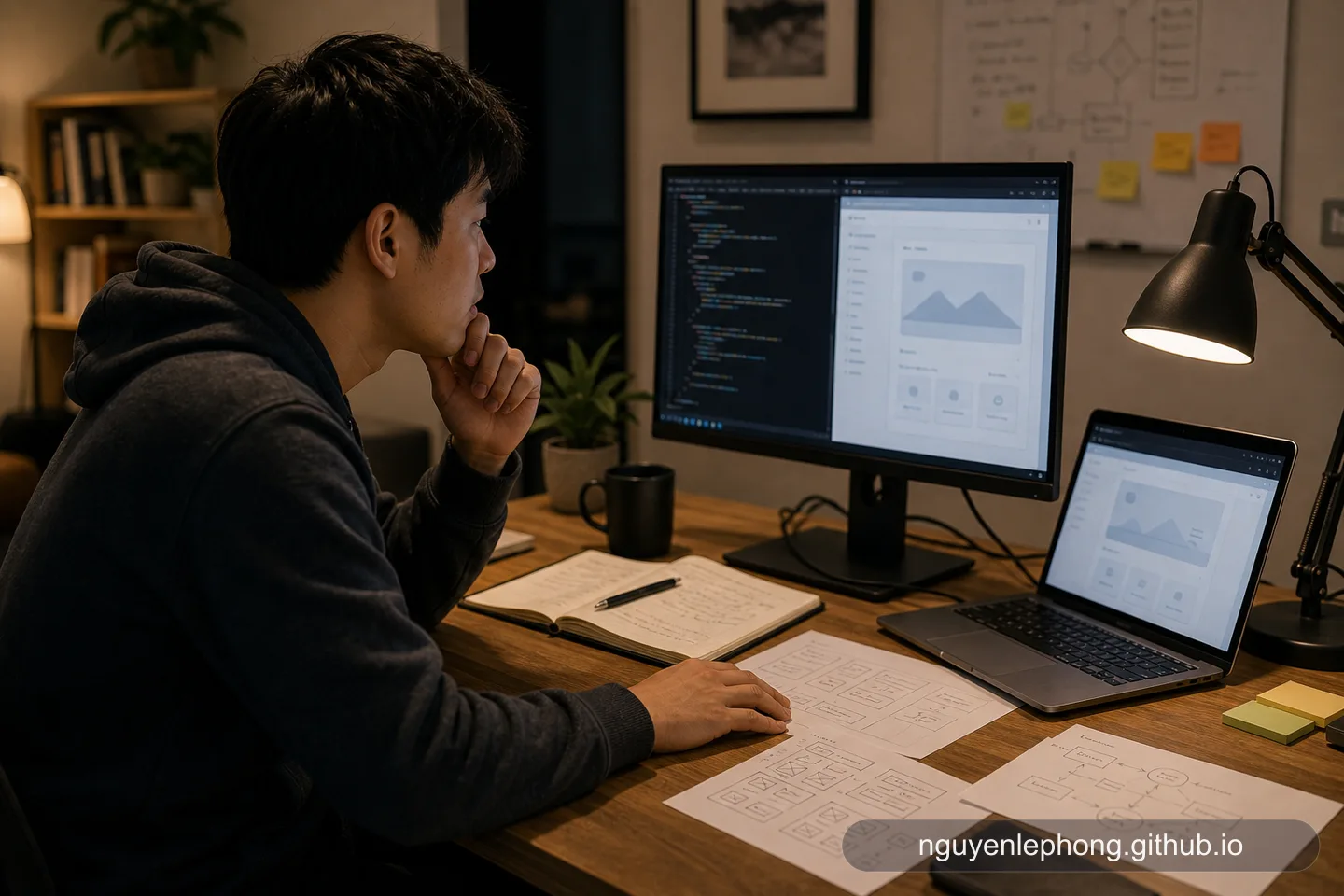
There is a kind of learning that only appears when you own the whole shape. In a job, one person may handle backend, another frontend, another design, another deployment. In a side project, even a small one, you meet the entire path: idea, scope, data model, UI, error states, deployment, documentation, and maintenance. You learn why a simple feature becomes more complicated after it has users, even if the only user is yourself six weeks later.
Side projects also reveal taste. Not taste as decoration, but taste as judgment. What do you consider simple? What do you cut when time is short? Which naming style feels clear after a month? How much automation is enough? When does a feature become clutter? These small choices help you understand your own engineering values. They also make your opinions at work less borrowed. You are not only repeating best practices. You have felt the trade-offs in your hands.
They can become career signals, but that should not be the only reason to make them. A side project can show initiative, depth, product sense, writing ability, design care, or persistence. It can help an interviewer see how you think when nobody handed you a perfectly defined requirement. But if every side project is treated as a public performance, it becomes heavier than it needs to be. Some projects are meant to be shared. Some are meant to teach you quietly and stay private.
The unfinished projects matter too. Many folders do not become products. They become lessons. You learn that an idea was too broad, a stack did not fit, a workflow was not painful enough, or your energy was needed elsewhere. That is not waste. It is inexpensive discovery. In a professional project, learning too late can cost a team months. In a side project, learning early may cost only a few evenings and leave you with sharper judgment.
A healthy side project stays small enough to survive real life. One useful page is better than a platform that never opens. One script that saves ten minutes every Friday is better than a grand tool that creates another maintenance burden. The project should give energy more often than it takes it. When it becomes another source of guilt, it may need to be paused, simplified, or allowed to end with gratitude for what it taught.
For engineers, side projects are also a gentle way to reconnect with craft. Work can sometimes become meetings, coordination, tickets, incidents, and careful compromises. A small project brings back the direct feeling of shaping something. You press a key, a test passes, a page loads, a small annoyance disappears. That feedback is not everything, but it can remind you why building attracted you in the first place.

The quiet value of side projects is accumulation. A small authentication demo helps later when a production bug appears. A half-finished notes app teaches data modeling. A simple dashboard improves your sense of information design. A toy AI agent clarifies where automation helps and where review matters. None of these moments may look important alone. Over time, they become a private library of experience.
Side projects matter when they make you more curious, more capable, or more honest about the trade-offs of building. They do not need to become companies, portfolios, or proof of discipline. They can simply be small places where learning has room to breathe. If you have a project like that, finished or unfinished, it may be worth asking what it quietly taught you that formal work could not.