
“Where are we going for lunch?” might be the shortest question in any office chat, and the one that takes longest to answer. Someone sends a thinking sticker, someone says “anything is fine”, someone brings up yesterday’s rice place. By the time the group reaches the elevators, everyone is scrolling Google Maps through a few dozen places, and nobody has decided.
Somewhere new, it gets harder: your first evening in Đà Lạt, getting off a bus in Cần Thơ at 9 p.m., or a trip to Hải Phòng next week and you want to know what to eat there. After enough of these moments, I stopped thinking places to eat were the problem. Every town in Vietnam has plenty. What’s missing is one answer you trust enough to take in under a minute. So I built Ăn Gì, a free app that picks where to eat (the name is Vietnamese for “what to eat”): pick what you are craving, and it picks one place near you or where you are heading, with a directions button. It runs in the browser, with nothing to install.
How Ăn Gì picks one place for you
The home screen asks “What to eat today?” and shows tiles for cravings: coffee, hotpot, bún, egg noodles, hủ tiếu, BBQ, street snacks, late-night food, buffets. The tile order follows the clock. The day has five slots on Vietnam time: morning, lunch, afternoon, evening and late night. Mornings lead with phở, bánh mì, sticky rice and coffee; evenings with hotpot and grills. Pick a tile and the app picks one place, with the address, what to order, and a button that opens Google Maps directions.
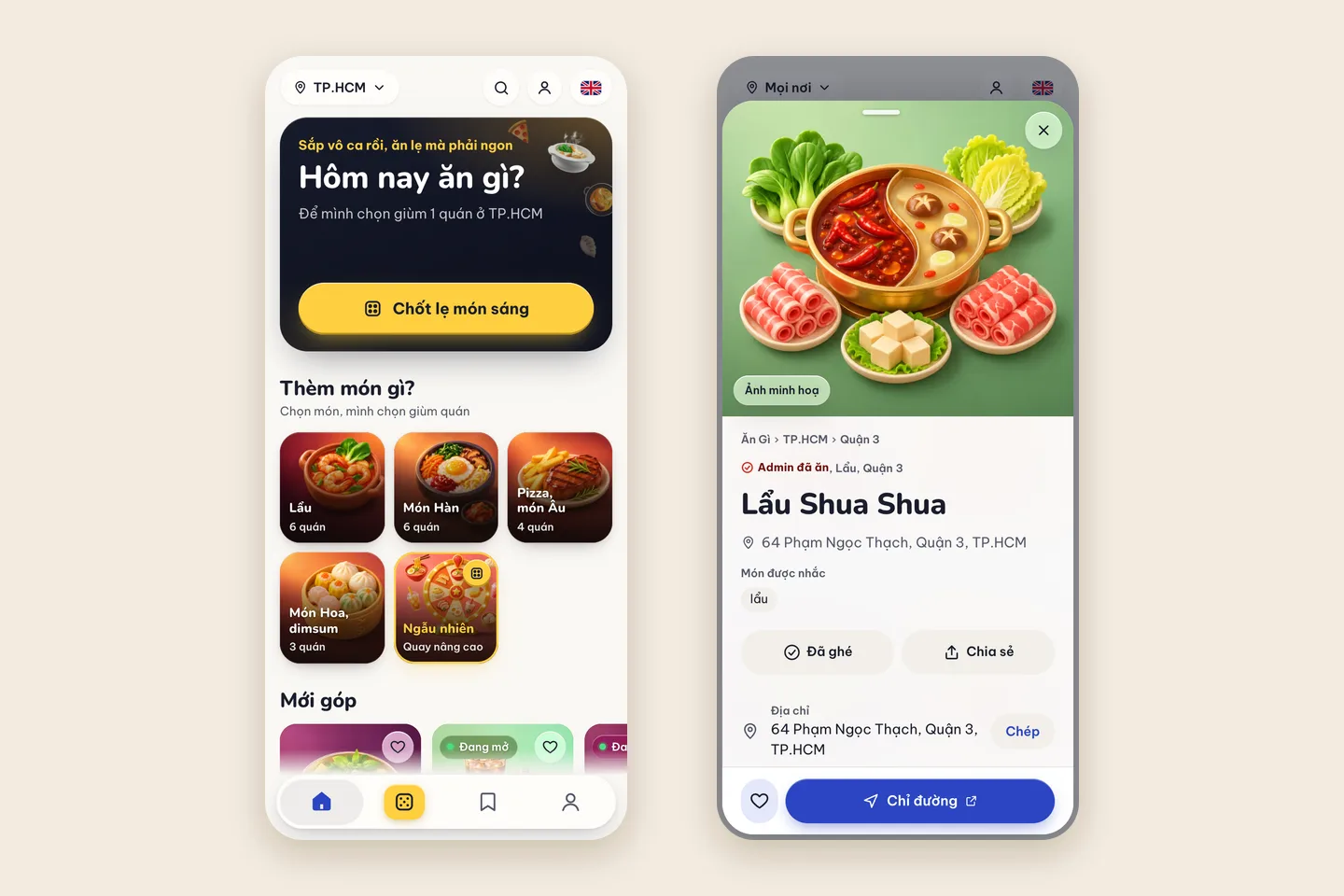
Give it 20 seconds: open Ăn Gì, pick “bún” or “hotpot”, and see where it sends you. If someone in your group always answers “anything is fine”, send them the link.
Wherever you are, turn on “Near you” to find places to eat near you. The app takes your location and finds places around it, even in provinces where my notebook has nothing yet. To look somewhere else, switch the city at the top or choose “Anywhere”.
When nothing comes to mind, the spin page picks for you at random by the kind of outing: Eat, Snacks, Drinks, Beer & bites, Date, Go out or Anything. Add conditions if you want them, such as cheap, open now, open late, near you, or only among places you saved. Places with unknown hours still show up under “open now”, because I would rather leave the hours blank than guess that a place is open.
Search ignores Vietnamese diacritics: “oc” finds snail places, and “q3” or “district 3” both mean District 3. Visitors can type “pho”, “snail” or “coffee” and get the right dish. Save the places you like and mark the ones you have visited. Add the page to your home screen and it opens like a regular app. I wrote the English interface myself, so it works for visitors and for anyone eating out with friends who do not read Vietnamese.
Traveling in Vietnam? See what to eat there first
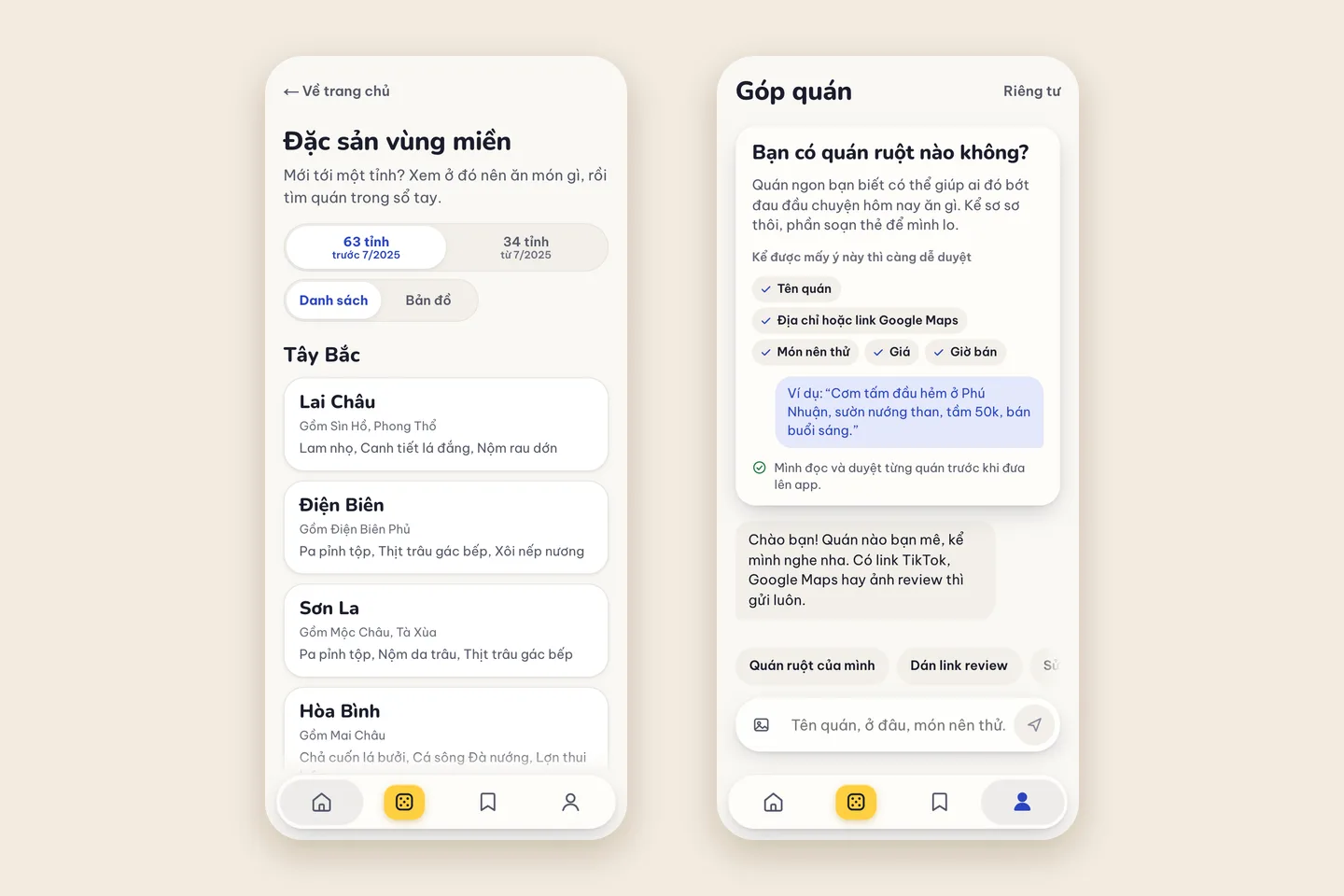
Before a trip, the question becomes “what do people eat there?” The Vietnam food by province guide answers it for the whole country. Hà Giang has thắng cố and cháo ấu tẩu. Hải Phòng has bánh đa cua and nem cua bể. Lạng Sơn has roast duck and phở chua. The guide has a list and a map, and you can browse the 63 provinces and cities from before July 2025 or the 34 since 1 July 2025. Tap a dish to see places for it in the app’s notebook. Where the notebook has none yet, you get a ready-made Google Maps search for that dish. Each dish needs at least two sources from two different sites before it goes in.
The map always includes the Hoang Sa Archipelago (Da Nang) and the Truong Sa Archipelago (Khanh Hoa).
If the city you are heading to is already in the notebook, pick it on the home screen and save a few places before you leave. On the spin page, choosing “Go out” lets you pick by city. Once you arrive, turn on “Near you” as usual.
Why picking a place to eat is tiring
The famous jam study by Iyengar and Lepper (2000) is the usual starting point: with 24 jams on the tasting table, 3% of the people who stopped bought one; with six, about 30% did. Later studies did not always reproduce it. In 2015, Chernev and colleagues pooled 99 such results and found people get overwhelmed more easily when the options are complex, the decision is hard, they are unsure what they want, and they just want to get it over with. That reads like 11:45 in an office, and even more like a city you don’t know: hungry, short on time, a hundred places around you and none of them familiar.
In Vietnam, the question comes back every week. According to the 2025 report by iPOS.vn and Nestlé Professional, about three in four diners eat lunch out at least once a week. Places also open and close constantly: the same report counts more than 50,000 outlets closing in the first half of 2025 alone. A “best places to eat” list from last year is probably partly wrong already.
Existing tools give you either too little or too much. A food spinner wheel lands on “bún bò” and leaves you to find where. Maps and delivery apps hand you hundreds of places to filter yourself, with star ratings, and in 2025 alone Google had to block or remove more than 292 million policy-violating reviews. A lot of what you scroll past is made by the restaurants themselves, too: iPOS figures for 2024, as reported by Znews, show 59.7% of outlets relying mainly on a Facebook page and 17.1% paying KOLs or KOCs for reviews. Nothing wrong with ads. It just helps to know when you’re reading one. Ăn Gì sits between the two ends: one real place, with a source, where you need it.
Add your own favorite place
Everyone has a few places they keep going back to, in the city they live in or back in their hometown. On the add a place page, describe it briefly: the name, the address or a Google Maps link, what to try, the price and the hours. If you have a TikTok review link, paste it along with a few words about the place. The assistant drafts a place card, you check it and send it, and I review every place before it goes live. The same page is where you report a place that has closed or details that are wrong. The notebook grows in a province when people from that province add to it.
The place data (names, addresses, hours, prices, dishes) is open under CC BY 4.0. You may reuse it, commercially too, as long as you credit “Ăn Gì” with a link to the project. The videos, photos and captions in the original reviews still belong to their authors. If you wrote a review and want details taken from it removed, send a note through the add-a-place page and I will handle it within 48 hours. Everything works without an account, and your saved places stay in your browser. An account only keeps that list when you switch devices.
Where the places come from, and what I left out
Ăn Gì has two sources of places. The first is a curated notebook. For a long time, whenever I ate somewhere good or saw a food review worth trying, I saved a screenshot to a photo notes app with a few lines: the name, the address, what to order. Those notes you return to later add up to 326 notes and 454 places as of 17 November 2026. I live in Saigon, so most are in Ho Chi Minh City (370), and the rest are spread across Đà Lạt, Vũng Tàu, Phan Thiết, Cần Thơ, Bảo Lộc, Cam Ranh and even Penang in Malaysia. The second source is places around your location, looked up live when you tap “Near you”. That is how a province missing from the notebook still gives you something to pick.
For the notebook, the hardest part was deciding what to keep. AI is very willing to make a place card look complete, even if it has to invent the opening hours. I treat AI output as draft evidence and set the opposite rule: a detail stays only if that same note, plus the text read from its screenshot (OCR), backs it up.
- A place name needs at least 60% of its words in the source, or the whole place is dropped.
- Every number in an address or opening hours must appear in the source.
- A price needs an actual number such as “35k” or “35.000”; a vague “cheap” is dropped.
- A phone number must appear digit for digit in the source.
- Summaries written by the model are always removed.
Thanks to this rule, everything the app shows traces back to an original note, and every place page credits the review account it came from. Places from my own notes carry an “Admin đã ăn” (admin ate here) label; places other people suggested do not. The photos are AI-generated illustrations of the dishes, labeled as such, not photos taken at the place, because the photos in the original reviews belong to the people who took them. The app’s about page spells out these rules.
Under the hood: search, location and data
If you don’t write software, feel free to skip to the next section. The short version: the server does not store your coordinates, and no place goes live until I approve it. The rest is for anyone curious about how it runs.
Ăn Gì runs on Next.js 16 and React 19, with data in PostgreSQL 16 through Drizzle ORM, and migrations run when the app starts. Everything runs with Docker Compose on a VPS and reaches the internet through a Cloudflare Tunnel, so the server opens no public ports. Pages are cached by tag, and approving a place refreshes the cache.
Search without diacritics
Search runs on the device on every keystroke, with no server call. Text is lowercased, stripped of diacritics, “đ” becomes “d”, and matching works on word starts, so “oc” finds “Ốc” but not “Học”. Each field has its own weight: the name counts most, then tags, dish type, address and note. If you type with accents that differ from the place name, the score is halved, so “nhật” (Japanese) does not get mixed up with “nhất” (best).
The spin
By default the spin picks a dish first, then a place. If it drew one place straight from the whole pool, the dish with the most places, coffee for example, would come up far more often than any other. It also remembers the last three places and the last two dishes, so the next spin does not repeat them unless nothing else is left. After midnight, the app treats the time as the previous day’s late-night slot until 5 a.m., because someone eating at 1 a.m. is still out for a late-night meal.
Near you and your location
On your device, the app only remembers your location rounded to about 100 m. When you search nearby, the server receives the position and immediately rounds it to a grid cell about 1.1 km wide. Only that cell goes to HERE, which searches within 2 km and widens to 5 km if there are too few results. Results carry the name, address, position and opening hours, ranked open places first and then by distance. They live only in a 30-minute cache per cell, never in the database, and the server does not store your coordinates. Distance is the straight-line distance times 1.3, which lands closer to real road distance.
The add-a-place assistant
The add-a-place page uses Claude Haiku with three tools: propose a new place, propose an edit, and propose an idea. The system prompt is cached so each chat turn costs less. The model is told not to invent anything and to ignore any instruction inside content a user pastes in. Every draft card is checked against a schema before you see it, and then I review each place by hand.
The codebase has more than 1,000 Vitest tests, more than 200 Playwright tests, and 24 ADRs recording the architecture decisions. I write the ADRs for myself a few months from now, when I have forgotten why nearby search uses HERE and not Google Places.
Where Ăn Gì goes next
Ăn Gì is in its soft launch, and I want honest feedback from real users so it picks better. Next on the list:
- A group room where everyone votes and the group lands on one place.
- Adding a place by sharing a Google Maps link straight into the app.
- A short question after you visit, so the data gets cleaner over time.
- A list of places open over Tết.
Further out: filling in the notebook for more cities, starting where real users are, and a look at a Zalo Mini App version. I think the lasting value is the data: a dataset of places to eat where every place traces back to a source, open under CC BY 4.0, growing through suggestions that a person reviews.
What building it taught me
A little data that is right holds up better than a lot of data that is guessed. Every detail in the app has a source, so nobody has to walk up to a closed door to learn the hours were a guess. It is the same lesson as confidence is not evidence at work. I also learned to launch once the app did one thing well, without waiting for the notebook to cover every province. “Near you” and people’s suggestions fill in the gaps over time.
Looking back, Ăn Gì started from a few hundred small notes, each a few seconds long. At the time I had found a good place and did not want to forget it; building an app never crossed my mind. Keep a small habit going long enough, and it’s already there on the day you find a use for it.
Tomorrow at lunch, before the group gets to the elevators, try opening Ăn Gì once and let it pick. If the pick misses, tell me. If you have a favorite place it doesn’t know yet, add it on the add a place page. Every piece of feedback helps it pick better for the next person.