
Day 1, the note is one line: “Review went fast today. The PR opened with the one question the author needed answered.” It feels too small to keep. Day 6: “Standup ran long. Nobody knew what we were deciding.” Day 13: “Design chat took 15 minutes. The doc said up front which option we had to pick.” By day 30 you have a pile of lines, and three of them are the same lesson in different clothes: things move faster when someone writes the question down first.
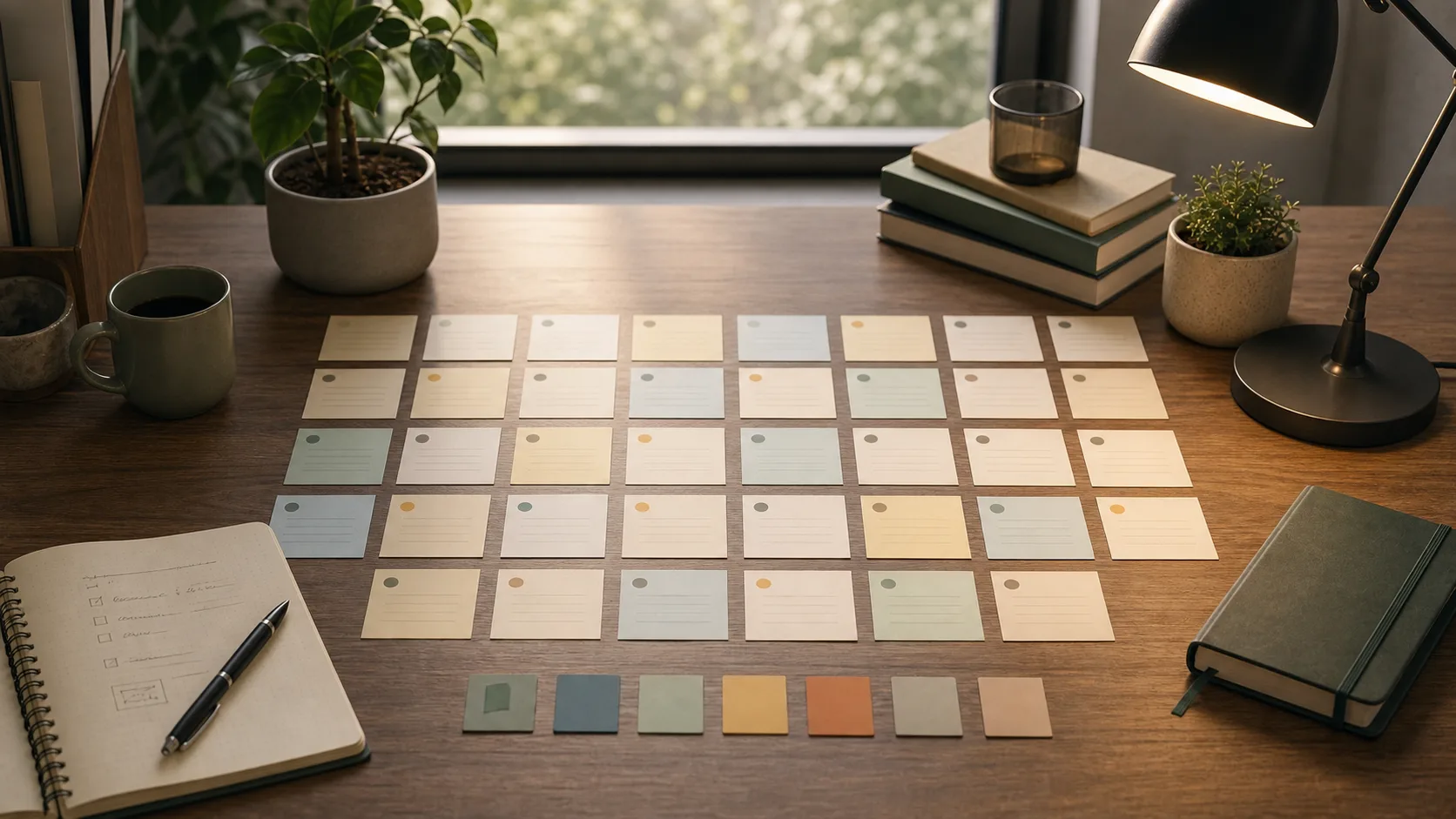
That’s the case for a month of small notes. One note looks random. Thirty start to show you what keeps happening. Below: what research says about writing at the end of the day, what to put in each note, and how to read the pile once the month is up.
What the diary studies found
Teresa Amabile and Steven Kramer ran one of the best-known studies of daily work diaries. They collected confidential daily diaries from 238 white-collar employees at seven companies, some 12,000 entries in all. Each entry answered prompts like “Briefly describe one event from today that stands out in your mind.” On the best days, by far the most prominent event was making progress (HBS Working Knowledge, and the authors’ own summary in The Power of Small Wins). Those diaries were a research method, so the study doesn’t tell you what keeping one does for you. It does show how much a one-line answer to “what stood out today?” can hold once you have enough of them.
A second study gets closer to the habit itself. Giada Di Stefano, Francesca Gino, Gary Pisano and Bradley Staats worked with trainees at a Wipro tech-support call center in Bangalore. From day 6 to day 16 of training, one group spent the last 15 minutes of each day writing about and reflecting on what they had learned. A control group kept working through those 15 minutes. On the final training test, the writing group did 22.8% better than the control group (HBS Working Knowledge). That’s one training program and one test score, so keep the claim small: in that setting, fifteen minutes of writing beat fifteen more minutes of work.
Keep each note small and plain
Daily notes don’t need to be impressive. They work better plain. Each day, one of these is plenty:
- One thing that went better than expected, and why you think it did.
- One bit of friction: a meeting that dragged, a build that broke twice, a question nobody could answer.
- One sentence someone said that changed a decision.
- One mistake that stayed small because someone spotted the risk early.
Write what happened before how it felt. “Frustrated with the release” won’t mean much in three weeks. “Release slipped a day because QA got the build at 5 p.m.” will. You’ll need that detail, because you will forget most of the month. Julia Evans makes this point in her post on the brag document: whenever she goes back through her work, she ends up finding small, and sometimes not-so-small, things she had completely forgotten she did.
On day 30, read the whole pile
The notes pay off when you read them together. Block half an hour on the last day and go through all of them in one sitting. A few questions help:
- Which problem shows up three or more times under different names?
- Which days gave you energy, and what did they have in common?
- What did you spend time on that never became a ticket or a feature?
- Which lesson do you want to try on purpose next month?
Don’t skip the third question. Evans points out that fuzzy work, such as building a stronger culture of code review, is exactly what people leave out when they describe what they did, because they don’t know how to explain why it matters. It’s also the work most likely to go unnoticed. A month of notes gives you that evidence in your own words: how your judgment changed, how your explanations got clearer, where your bar for quality moved. Bring it to your next 1:1 or performance review and it does a lot of the remembering for you.
The pile that surprised me
The small notes that turned out most useful to me had nothing to do with engineering. For a long time, whenever I ate somewhere good or saw a food review worth trying, I saved a screenshot to a photo notes app with a few lines: the name, the address, what to order. Each one took a few seconds. By 17 November 2026 there were 326 of those notes covering 454 places, and they became the curated notebook behind Ăn Gì, the app I built to pick where to eat. When I saved the first one, building an app never crossed my mind. The pile was just there once I found a use for it.
Thirty days, then decide
Treat the month as an experiment with an end date. Sometimes thirty days is enough to see the pattern, and then you can decide what to keep, what to stop, and which note deserves a proper write-up. If the habit sticks, the note you come back to months later gets even more interesting. If the blank page is what’s stopping you, start with one rough note.
Start tonight. Before you close your laptop, write one line about the day. If it feels too ordinary to bother with, write it anyway. Most of what this month can teach you is sitting in the ordinary days.