
A few friends have asked how I actually read my books, and I noticed I kept giving the same slightly embarrassed answer in person. So I am writing the process down once, properly, here.
For a long time my relationship with reading was more complicated than I liked to admit. I would “finish” a book, feel genuinely moved by it, and then someone would politely ask, so what is it about? — and I would stumble through “it’s something like this, like that… I promise it’s better than what I just said.” That small embarrassment, repeated enough times, made me want to be more deliberate: to get more comprehension and more retention out of the same hours of reading.

Looking back, the struggle had three familiar shapes. I suspect they will resonate with more people than just me.
Only a vague sense of the book, after a while
Here is the gentle surprise: there is nothing inherently wrong with this. What you can actively recite is only the declarative layer of a book — and it was never the only thing you took away. A good part of what a book gives you settles somewhere non-verbal: a worldview, a feeling, a pattern that will quietly match itself against a real situation years later. The book changed you even when you cannot recite it. I stopped treating a hazy memory as proof of a wasted read.
The guilt of the unfinished book
You have my full sympathy here. That nagging feeling when you abandon a book — because it turned boring, or difficult, or your curiosity simply moved house — comes from a completionism instinct we all carry. But it rests on a fuzzy idea of what “done reading” even means. What separates a careful, analytical read from one mindless pass cover to cover?
Sitting with that question changed how I hold books altogether. My shelf became a tsundoku — a standing collection rather than a queue of tasks — and I read across books by theme rather than one at a time, the way syntopical reading suggests. When I decide to adopt a book after a first inspectional pass, it is here to stay with me indefinitely. I feel no guilt putting it aside for a season. I even enjoy knowing part of it is still undiscovered, waiting. There is a particular joy in returning to a passage of an ever-complete book years later, now carrying the real-life experience that makes it land.

The dread of re-reading what you half-remember
This one interested me most, because unlike the other two it cannot be fixed by flipping a mindset switch — it is a mechanical problem. The pain lives in a small dilemma: you have a hazy memory of having read a passage, but the memory is hazy enough that you feel you must read it again. Multiply that across several books read in parallel and it gets expensive.
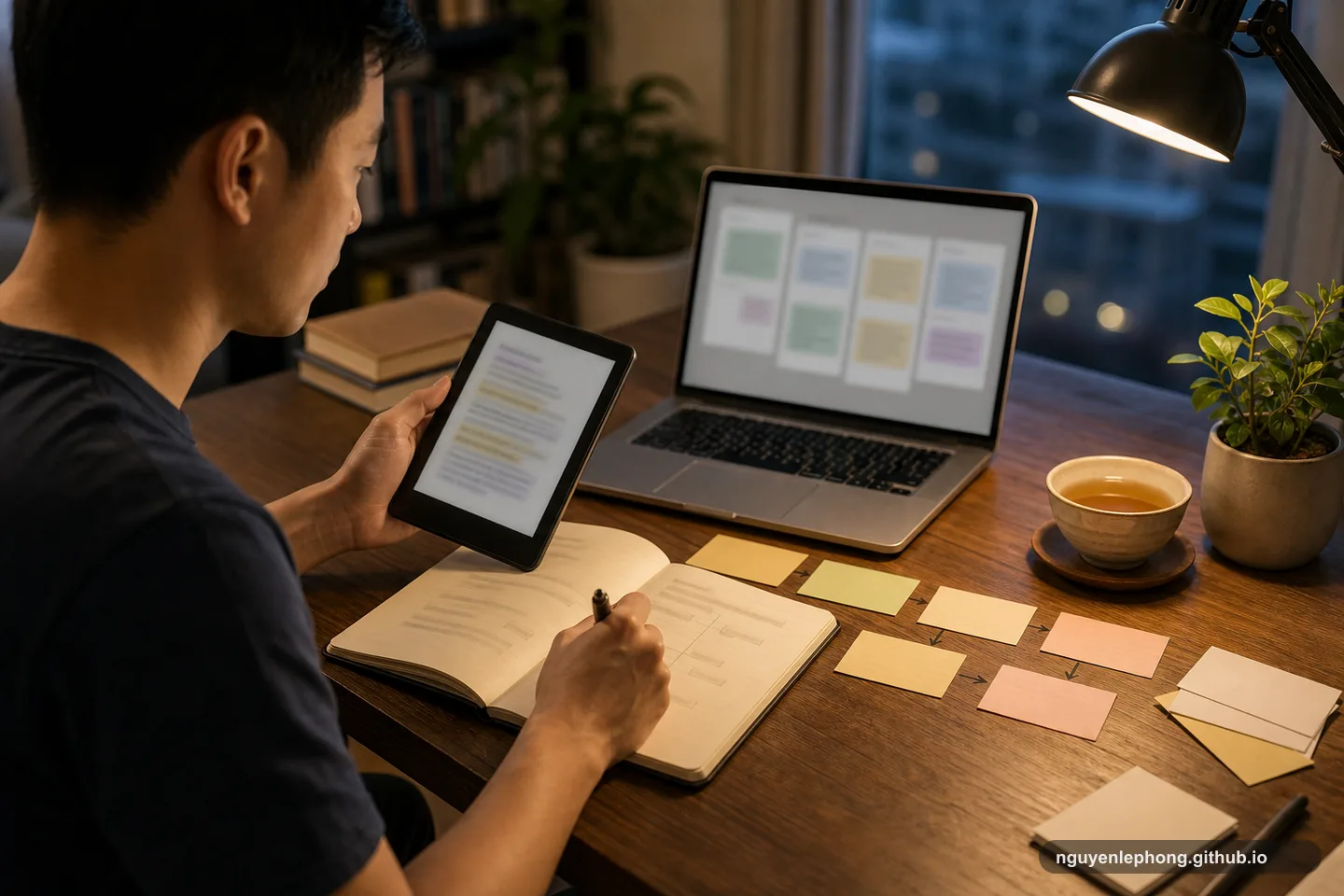
So I built a small pipeline. I highlight while reading on Kindle; the highlights sync into Readwise; from there they flow into my notes, where I progressively summarize them and let spaced repetition surface them for review. Each step is a natural filter — not everything survives the whole journey, and that is the point. What remains is a searchable library of the passages I found worth keeping, arriving when I need them instead of being re-read when I don’t.
None of this makes me a faster reader. It just made reading feel like tending something that accumulates — which, for me, was the whole problem to begin with.