
The pull request fits on one screen: a renamed helper, one new test, a short branch condition. The only comment says "this name is confusing." The author renames it, the reviewer approves, and nobody will remember the PR next month.
Someone will remember the comment, though. Next week a new hire spends an afternoon reading recent PRs to learn the codebase, and this is one of them. They don't learn much about the helper. What they pick up is how people here talk about each other's work: short verdicts, no reasons, and the author guesses the rest.
Where culture actually shows up
Teams describe their culture with big words: ownership, quality, trust, psychological safety. Those words only mean something if they hold up in ordinary moments, and in an engineering team few moments are more ordinary than a small review. Most of the reviews you'll ever do are on diffs like this one. That's where people decide, a few comments at a time, whether quality here is a shared craft or one person's judgment.
Google's review guide counts teaching as one of the jobs of review. Its section on mentoring says it's "always fine to leave comments that help a developer learn something new," as long as you mark the purely educational ones as optional with a "Nit:" prefix (The Standard of Code Review). The same guide sets the bar at continuous improvement: approve once a change "definitely improves the overall code health of the system," even if it isn't perfect. A small review is where that balance gets practiced most often.
Same concern, two comments
Here's the naming comment again, written two ways.
- "This name is confusing."
- "I had to reread
applyPricebecause it sounds like it changes the price, but it only formats it for display. Could the name say that, maybeformatPriceLabel?"
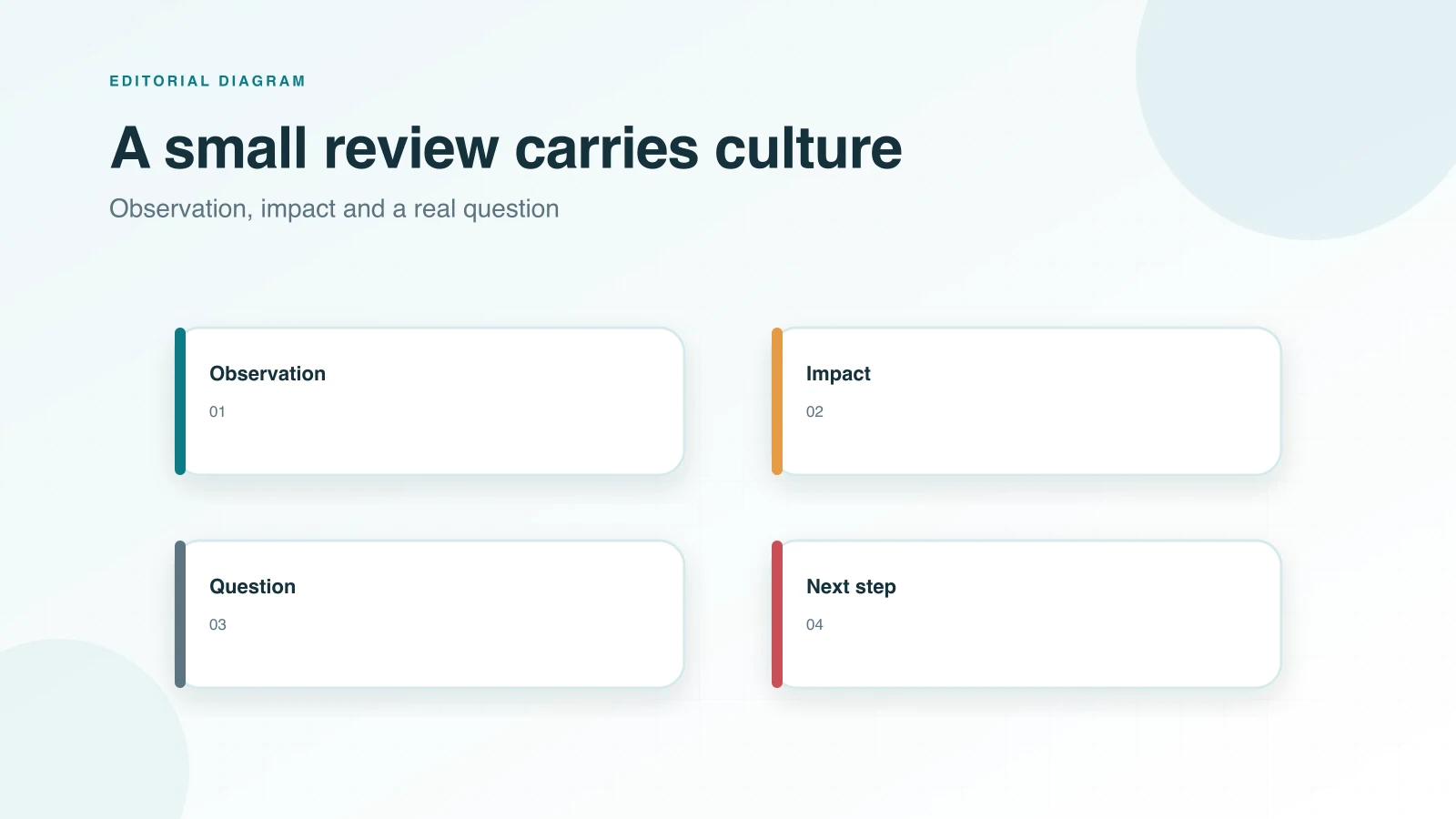
Both ask for the same change. The second follows the four cards in the picture above: what you saw, why it tripped you up, a question, and a direction. It also teaches something the author can reuse next time they name a function.
Tone affects whether the comment gets used at all. A 2019 Google Testing on the Toilet post on respectful reviews cites earlier research where authors found very negative comments useful 57% of the time and more neutral comments useful 79% of the time (Respectful Reviews == Useful Reviews). The same post gives advice that fits on a sticky note: assume competence, give your reason or a link, and talk about the code, since even "you" or "your" can make a comment feel personal.
Pushback is rare, and it sticks
Google studied the bad side of this directly. Carolyn Egelman, Emerson Murphy-Hill and colleagues surveyed 1,317 developers and matched their answers with review logs (Predicting Developers' Negative Feelings about Code Review, ICSE 2020). They define pushback as "the perception of unnecessary interpersonal conflict in code review while a reviewer is blocking a change request."
The overall picture is good: 87% of developers were at least moderately satisfied with code review, and 96% said it improves their code at least a moderate amount. Still, 57% reported a negative review experience at least once a quarter. In a sample of ordinary change requests, 11% carried at least one feeling of pushback. One of the five feelings the researchers measured is the one that matters for culture: the author didn't feel positive about submitting similar changes in the future.
A later Google study found that pushback doesn't land evenly. Women faced 21% higher odds of pushback than men, and Black+, Asian+ and Latinx+ developers faced 54%, 42% and 15% higher odds than White+ developers. Google estimated the excess pushback costs it more than 1,000 engineer hours per day (Using research to make code review more equitable). Small comments add up, and they add up faster for some people than for others.
Authors set the tone too
Review is a two-way conversation, so the author's replies teach the team as much as the reviewer's comments. "Good catch, I missed the retry case, added a test" keeps the thread collaborative. Ignoring comments, pushing unexplained changes, or treating each suggestion as an attack teaches a different lesson. Google's tips ask authors to reply to every comment or clarify the code, because silence can read as not caring about the feedback.
Context helps from both sides. A reviewer who asks for a test without saying why may be right, and the author learns little. A reviewer who adds "this branch guards the retry path we broke in March" passes on a piece of system memory. An author who explains a choice in the PR saves the reviewer from guessing. For more on that side, see the post on reviewers as future readers.
Small diffs are where you practice
Size doesn't make the culture smaller. Small reviews are the easiest place to build habits because the stakes are low: nobody's job depends on a helper's name. If a team can't be careful and friendly on a 20-line diff on a Tuesday afternoon, it won't manage it on a risky migration at 2 a.m.
Over time people learn the weather of a codebase. Is it safe to ask a basic question? Will a concern get heard? Can someone name a mistake without being embarrassed? That weather gets built one comment at a time, mostly on PRs nobody will remember. For the practical side, How to Review Code Kindly covers phrasing and comment labels, and the post on making room for careful reviewers covers who gets heard.
Try this week
- Pick your last three review comments and read them as a new hire would. What do they teach about how people talk here?
- On your next small PR, add one sentence of "why" to every comment that asks for a change.
- As an author, reply to every comment, even if it's just "done" or a short reason you didn't change it.
- Leave one specific, genuine compliment on a PR that seems too small to bother with.