
The alert goes off at the worst possible time, the way alerts do. Error rates climbing, a dashboard turning red, a channel filling with worried messages. And almost immediately, the pull begins: do something. Restart the service. Roll back the last release. Push a hotfix. Anyone who has been in an incident knows the physical feeling of it — the urge to act now, to make the red go away, to be seen doing rather than thinking. And then, sometimes, one steady voice asks the most uncomfortable question in the room: "Before we touch anything — what do we actually know?"
That pause costs something. It feels like standing still while the building is on fire. But the people I have learned the most from in hard moments were almost always the ones willing to sit inside that pause a little longer than felt comfortable.

Two relationships with disorder
Abraham Zaleznik noticed something about how people relate to order and disorder. Some of us are wired to restore order as fast as possible — sometimes before we fully understand what we are ordering — because disorder itself feels like a threat to be neutralized. Others can tolerate ambiguity: they can hold a problem open, unsolved, and study it from a few angles before reaching for a conclusion.
It is worth being plain about one thing here, because the original idea is sometimes dressed up in grand, almost mystical language. This is not a fixed personality, and it is not a gift some people are simply born with. It is a disposition — a learned relationship with not-knowing — and like most dispositions, it can be practiced. The calm voice in the incident is usually not braver by nature. It has just done this enough times to trust that understanding pays for the pause.
Why we rush to close
Order feels safe, and it looks competent. "Doing something" is visible and gets rewarded; sitting and thinking looks, from the outside, a lot like doing nothing. We close the ticket quickly because a closed ticket is legible — it can be reported, counted, pointed at in a standup. Understanding a problem slowly produces nothing you can put on a board until it is done.
It is the difference between tidying a room and diagnosing why the room keeps getting messy. Tidying you can show within the hour. Diagnosis asks everyone to trust that the quiet, unglamorous looking-around will be worth more than the immediate cleanup. Under pressure, with people watching, the immediate cleanup almost always wins — which is exactly why the discipline matters.

The cost of solving before understanding
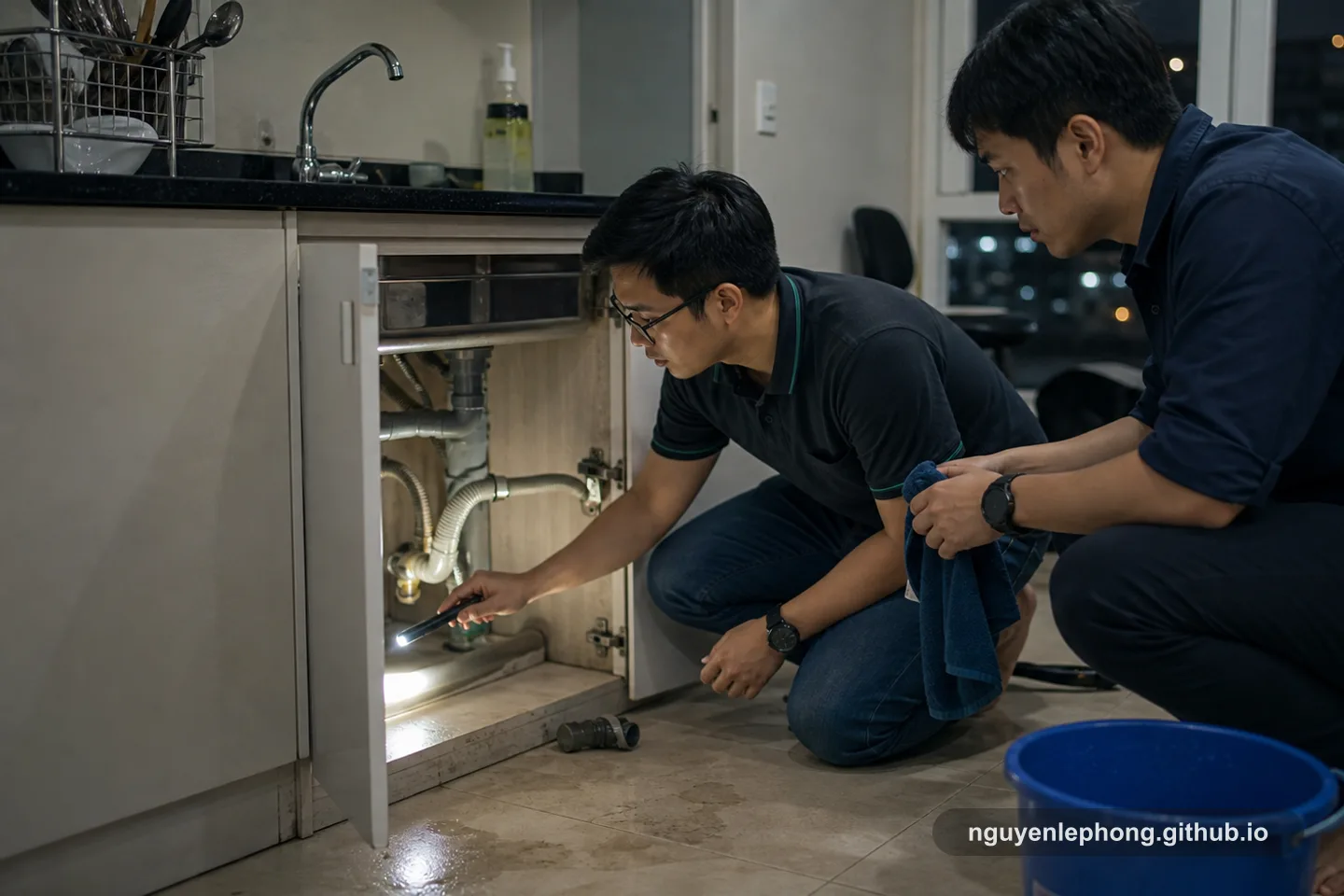
A fix that lands fast often treats the symptom. The root cause, untouched, comes back the next week wearing a slightly different mask. It is the household version of mopping the floor under a leaking pipe: every evening you wipe it dry and feel like you handled it, and every morning the puddle is back — because the thing that would actually end it, finding the pipe and understanding why it leaks, was slower, messier, and never quite as satisfying as the mop.
Worse, we sometimes solve a problem we never actually defined — we answer a question nobody asked clearly, and feel productive doing it. There is a name for one version of this trap: the Einstellung effect, where a familiar solution comes to mind so readily that it blinds us to the better one the situation actually needs. The faster we move to close, the more likely we are to grab the tool already in our hand instead of the one the problem is asking for. Speed and the familiar are quietly in league with each other, and both feel like competence in the moment.
Keeping the answer in suspense
The quiet skill underneath good debugging and good leadership turns out to be the same one: the willingness to keep the answer in suspense. To say "I don't know yet" out loud, and stay in it long enough to genuinely understand. This is how a careful scientist or a patient investigator works — not slowly for the sake of slowness, but patiently, in service of getting the problem right before reaching for an answer.
It is the opposite of dithering, even though from a distance they can look alike. Dithering avoids the problem; it circles because deciding is scary. Suspense engages the problem directly and refuses to flinch toward the nearest comfortable answer before the picture is clear. One is fear wearing the costume of caution. The other is patience doing real work.
It is trainable
The encouraging part is that tolerance for ambiguity is not a trait you simply have or lack. You can build it, in small ordinary ways. Name the discomfort when it arrives, instead of obeying it on reflex. Separate "stabilize" from "solve" — stop the bleeding with a rollback or a mitigation, but do not let the fact that the red went away convince you that you understood anything. Ask one more "what are we actually seeing here" before the fix goes in.
And learn to resist the social gravity of the meeting that wants everyone to leave with a decision, even when the problem is not yet understood well enough to decide. "I would rather we leave today knowing exactly what we do and do not understand, and decide tomorrow" is an unpopular sentence to say in a room that wants closure. It is also, often, the most useful thing anyone says all day.

The maturity is not in how fast you restore order. It is in how long you can stay with a genuinely hard problem without flinching toward a comfortable answer — and then move decisively, once you actually understand. When was the last time staying in the discomfort just a little longer changed the answer you reached? I would love to hear what it cost you to wait, and what it saved.