
Here's something few people tell men before they propose: getting married is a project. Not a day, but a chain of months — dozens of interlocking tasks, two families to reconcile, and a budget that can reach hundreds of millions of đồng. We romanticize weddings so much that we forget there's a full plan behind the flower wall — and the thoughtful man is the one who sees that early.
Being thoughtful here doesn't mean doing it all yourself or straining to play the "provider." It means knowing in advance which stages are coming, how much each costs, who handles what, and where you need to step up so the person you love doesn't have to figure it out by herself. Clear money from the start is how you protect the relationship from needless misunderstandings and pressure.
This guide follows the natural journey — dating → meeting the families → the formal proposal → the engagement → the wedding → after the wedding & honeymoon — and at each stage looks at two things: what to prepare and how much it costs. It comes with a detailed reference budget so you have real numbers to picture, instead of vague anxiety.
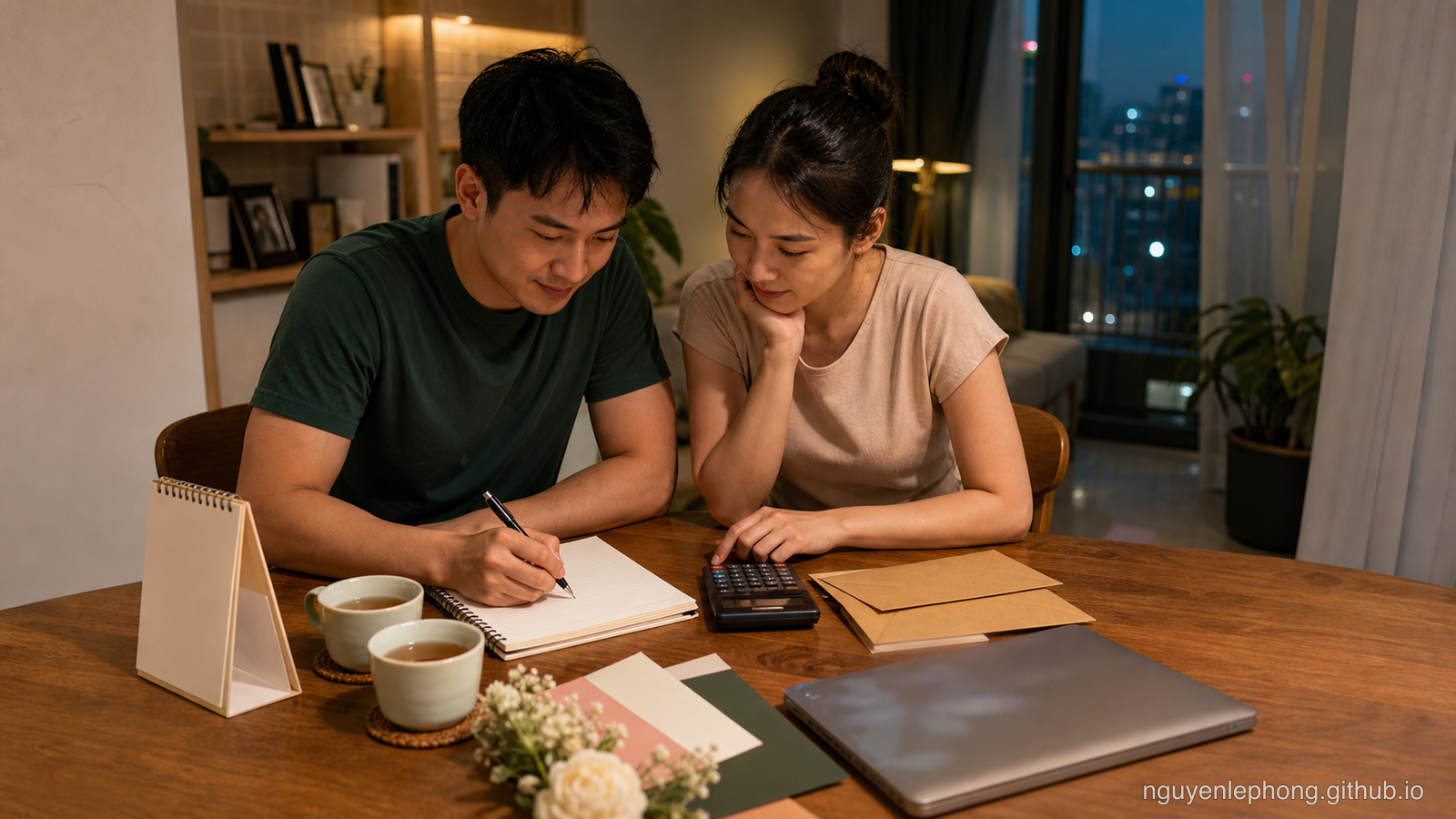
These figures are reference levels for a mid-to-upper-scale wedding in Vietnam, with engagement trays and a bride-price ritual. Wedding customs can vary by region and by family (number of trays, offerings, how the events are organized) — see a few regional variations below. Real costs also depend on the number of banquet tables, each family's customs, and local living standards. Use this as a skeleton to build your own budget, then adjust to the reality of both families.
The budget picture: how much does a wedding cost?
Before the stages, see the whole. Below is a reference cost table grouped by category so you can see where the money goes. The biggest line items are in bold — that's where to focus your attention when balancing the budget.
| Item | Reference cost |
|---|---|
| Bride price & ceremonies | |
| Bride price ("lễ đen" / dowry gift) | 88,888,000đ |
| Wedding rings | 50M |
| Engagement trays (tráp) | 7M |
| Lucky money for tray-bearers | 2M |
| Tray-bearing team / helpers | 20M |
| Banquet (the biggest item) | |
| Restaurant banquet, groom's side (15 tables) | 120M |
| Restaurant banquet, bride's side (13 tables) | 55M |
| Bride-fetching meal (at home) | 20M |
| MC / host | 5M |
| Saxophone / band (both families) | 6M |
| Photos & attire | |
| Pre-wedding photoshoot | 15M |
| Wedding-day video / documentary | 15M |
| Hotel for the photo shoot | 2M |
| Wedding dress & attire | 15M |
| Wedding shoes | 2M |
| Bridal makeup | 5M |
| Wedding portrait | 500K |
| Decoration & transport | |
| Ancestral-altar decoration | 20M |
| Wedding decoration (gate, hall, backdrop) | 10M |
| Wedding-night room decoration | 5M |
| Wedding flowers | 3M |
| Bridal car rental | 10M |
| Guest / convoy transport | 10M |
| Invitations | 3M |
| Hotel for out-of-town guests | 10M |
| Contingency | 10M |
Add up the whole table and it lands around ~700M. But note: the banquet is usually the largest block (~175–200M) and a good part of it is offset by guests' gift money. If you set aside the bride price (88.9M — largely symbolic and customary) and subtract the gift money coming back in, the "real cost" both families bear is often well below the headline figure. Don't let 700M scare you — break it down.
What does the groom's side cover? Conventions & tact
Customs vary by region, but there's a common framework a man should know so he can propose proactively, instead of leaving the two families to read each other's minds:
| The groom's side usually covers | The bride's side usually covers |
|---|---|
| Bride price, engagement trays, wedding rings | Banquet for the bride's guests |
| Restaurant banquet on the groom's side | Bride's attire & makeup (sometimes) |
| Bridal car, the bride-fetching convoy | Ancestral-altar decoration at the bride's home |
| Photos & video (often split, or groom covers) | The bride's dowry / parting gift |
| Altar & wedding-night room decoration on the groom's side |
The table above is only a starting point for conversation, not a law. These days many couples pool their budget and pay together, or cover most of it themselves so their parents have less to worry about. The single most important thing: talk about money early, clearly, and respectfully — with your partner first, then the two families. A grounded future husband is one who dares to sit down with the numbers, not one who avoids them until the last minute.
A few regional variations (for reference only)
This part is only a set of general observations for reference, not an attempt to generalize or to rank one region above another. Wedding customs are highly diverse — they differ not only between regions but between provinces, family lines, and individual households; and many families today simplify or blend them flexibly. The sole aim here is to help you picture what might differ so you can prepare thoughtfully. Every way of doing things deserves respect; what matters most is the agreement and comfort of both families.
| Aspect | Some places in the North | Some places in the Central | Some places in the South |
|---|---|---|---|
| Tray name & count | Often called "tráp"; the count is usually odd (5, 7, 9, 11) | Often kept compact (around 5 trays) | Often called "mâm quả"; the count is usually even (6, 8, 10) |
| How ceremonies are held | Often held as separate events (proposal, engagement, wedding) | Often place care on the sequence and an auspicious hour | Some hold the ceremonies close together or on the same day to keep it simple |
| Common offerings | Green-rice cake, phu-thê cake, tea, betel… | Some add a pair of dragon–phoenix wedding candles lit at the ancestral altar | Roast pig, gấc sticky rice, fruit trays, phoenix-folded betel… |
Customs often seen in the North
- Choosing more trays (7–11) raises the tray cost and the number of lucky-money envelopes for the tray-bearing teams — each extra bearer pair is one more envelope.
- Holding several separate ceremonies (proposal, engagement, wedding, return visit) adds offerings, travel, and time for each.
- The bride price usually sits in an envelope, the amount by agreement — best discussed with the bride's family first.
Customs often seen in the Central region
- Offerings are often kept compact; many families place care on doing the rites properly and on an auspicious hour.
- Some places add a pair of dragon–phoenix wedding candles lit during the ancestral rite — a lovely touch often seen around Huế.
- Some invite someone well-versed in the rites to preside, to make the ceremony more solemn.
Customs often seen in the South
- In many places the fruit trays include a roast pig and gấc sticky rice — which can be a little more than a compact tray set.
- If the reception is large, the catering (table count) is usually the most significant line in the budget.
- Some hold the ceremonies close together or more simply, saving time and some organizing cost.
When the groom's and bride's families come from different regions, customs may differ a little — and that's perfectly normal. Talk early, in a spirit of mutual respect, agree on a blended way to organize things, decide who prepares the rites at each place, and budget extra for travel, accommodation, and sometimes a reception in both places. The understanding and agreement of both sides are what truly make a beautiful wedding.
Stage 1 — Dating & building a "wedding fund"
A wedding doesn't begin at the jeweler or the restaurant — it begins long before, in how you prepare your own finances. Life's biggest expenses (a home, a wedding) rarely arrive by surprise; they arrive when you know they're coming.
- Open a separate "wedding fund." Keep it apart from spending money and contribute monthly. A 300–700M wedding becomes breathable when you've saved over 24–36 months instead of scrambling in the final weeks.
- Budget first, dream second. Know how much you can spend, then choose the scale — not the other way around, choosing a lavish scale and borrowing to chase it. Solid budgeting is covered in Build a Budget, Own Your Cash Flow.
- Keep a separate emergency fund. Don't drain everything on the wedding and walk into marriage with a zero balance. See The Emergency Fund from A to Z.
Borrowing for one glamorous day and then repaying it through your first year of marriage is an exhausting start. Financial pressure is one of the leading causes of stress for newlyweds. A warm, right-sized celebration is worth far more than a lavish one bought with debt.
Stage 2 — Meeting & visiting both families
This is the stage that costs the least but deserves the most effort. First impressions with your partner's family are formed here, and they'll follow you through everything that comes after.
- A meeting gift: it needn't be expensive, it needs to be thoughtful and on point. A fruit basket, a box of cakes, fine tea, or something matching the parents' taste. (Reference: 500K – 2M each visit.)
- Mental preparation: learn about the family, their likes, and what to avoid. Speak politely and with poise.
- Align your "line": before the two families meet, you and your partner should agree in advance on what you want (scale, date, budget) so you're not caught off guard when the elders ask.
This is where you show you're grounded and dependable. Bring up the future seriously and proactively; let both sets of parents see you have a clear plan. The reassurance you give the parents is worth more than any expensive gift.
Stage 3 — The formal proposal visit (lễ dạm ngõ)
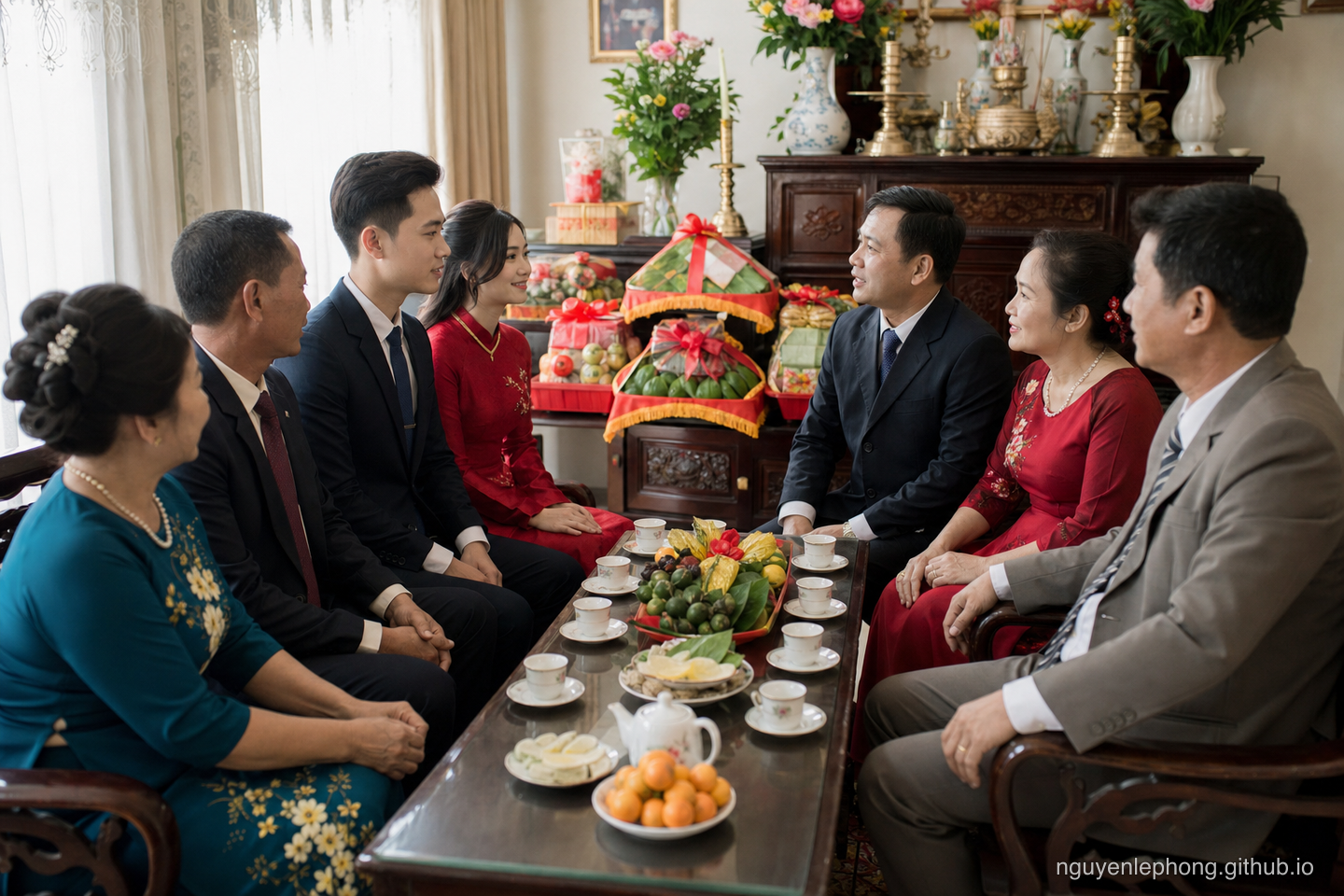
The dạm ngõ is the first official meeting between the two families — the groom's side visits to "speak the matter," asking permission for the couple to court and move forward. It's a small, warm, low-cost ritual, but an important beginning.
| What to prepare | Reference cost |
|---|---|
| Offerings: betel & areca, tea, cigarettes, sweets, fruit | 1 – 3M |
| Smart attire for the groom's party | (your own) |
| Intimate meal (if the bride's family invites you to stay) | bride's side |
What matters: pick an auspicious date, arrive on time, and keep the offerings neat and tidy. The size of the groom's party should be discussed with the bride's family beforehand. This is a ritual of respect — keeping it simple but gracious is plenty.
Stage 4 — The engagement ceremony (lễ ăn hỏi)
This is the first major ceremony, where the groom's side brings offering trays (tráp) to the bride's home to formally ask for her hand. The signature — and heaviest — expenses here are the bride price and the engagement trays.
| Item | Reference cost |
|---|---|
| Bride price (the sum the groom's side gives the bride's family) | 88,888,000đ |
| Engagement trays (commonly 5, 7, 9, or 11) | 7M |
| Lucky money for the tray-bearers | 2M |
| Tray-bearing teams (groom's & bride's) | 20M |
| Wedding rings (exchanged here or at the wedding) | 50M |
The figure 88,888,000đ is symbolic and customary — the number 8 stands for prosperity and luck. The amount varies widely by region and family (some 5–20M, some more). Many bride's families give part of it back to the couple as a nest egg. The key is to ask the bride's side first so the number carries a beautiful meaning, fits everyone's means, and leaves no one awkward.
On the number of trays (odd in the North: 5/7/9/11; even in the South) and their contents (betel & areca, wine & cigarettes, tea, sticky-rice cakes, fruit, roast pig…), agree with the bride's family so it's both customary and not overly showy.
Stage 5 — The wedding: the big day
This is the costliest stage with the most tasks. To keep it under control, break it into four groups.
The banquet — the biggest item
| Item | Reference cost |
|---|---|
| Restaurant banquet, groom's side (15 tables × ~8M) | 120M |
| Restaurant banquet, bride's side (13 tables) | 55M |
| Bride-fetching meal (at home) | 20M |
| MC / host | 5M |
| Saxophone / band (both families) | 6M |
Banquet cost is directly proportional to guest count. Cutting 5 tables saves ~40M. Build a real guest list (don't invite out of "obligation momentum"), and remember most of the banquet cost is offset by gift money — so it's both an expense and a two-way cash flow. Inviting the right people matters more than inviting a crowd.
Decoration, flowers & transport
| Item | Reference cost |
|---|---|
| Ancestral-altar decoration (both homes) | 20M |
| Wedding decoration (gate, hall, backdrop) | 10M |
| Wedding-night room decoration | 5M |
| Wedding flowers (bouquet, boutonnières) | 3M |
| Bridal car rental | 10M |
| Guest / convoy transport | 10M |
| Hotel for out-of-town guests | 10M |
Photos, attire & invitations
| Item | Reference cost |
|---|---|
| Pre-wedding photoshoot | 15M |
| Wedding-day video / documentary | 15M |
| Hotel for the photo shoot | 2M |
| Wedding dress + groom's attire | 15M |
| Wedding shoes | 2M |
| Bridal makeup | 5M |
| Wedding portrait & invitations | 3.5M |
The wedding-day flow & the groom's role
A typical wedding day: ancestral rites at the groom's home → the bride-fetching convoy to the bride's home → ancestral rites at the bride's home → bringing the bride home → the restaurant banquet. The groom's job isn't just to "show up and smile":
- Assign the logistics team: who holds the flowers, who carries the trays, who manages the envelopes, who greets guests, who keeps the gift money. Delegate to trusted people in advance.
- Keep a "lifeline": a backup envelope of cash, a power bank, and a list of vendor phone numbers (cars, photo, restaurant).
- Shield the bride from stress: she's the most tired and pressured person that day. The thoughtful husband steps up to handle incidents so his wife can actually enjoy it.
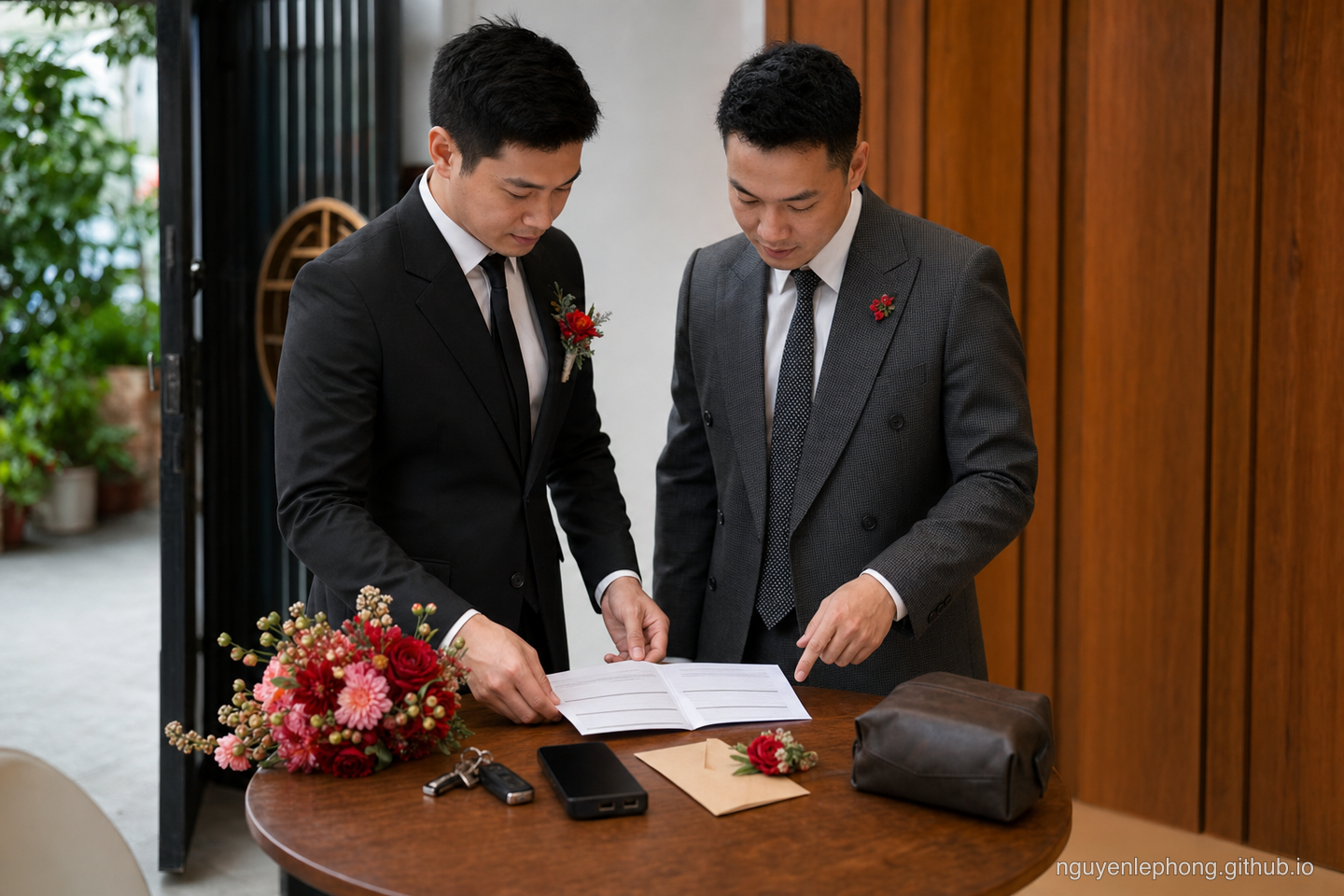
Set aside ~10M (or 10% of the budget) as contingency. Something often comes up: last-minute extra tables, broken items, surcharges, unplanned lucky money. Having a contingency means you handle the surprise with a smile instead of a panic.
Stage 6 — After the wedding: the return visit, registration & honeymoon
The party ending isn't the finish line. A few important things often get left out of the budget:
| What to do | Reference cost |
|---|---|
| Return visit (groom's side brings a small gift to the bride's home) | 1 – 3M |
| Marriage registration (legal procedure at the local authority) | nearly free |
| Domestic honeymoon | 15 – 30M |
| International honeymoon | 40 – 100M+ |
| Thank-yous / settling remaining bills | varies |
Amid all the festivities, marriage registration is what gives the marriage legal standing — it affects shared property, children, insurance, and inheritance. The procedure is simple and nearly free, yet many couples keep putting it off. Put it on the "important" list.
On the honeymoon: it's the first thing cut when the budget gets tight, but it's worth keeping — a few days of rest after months of stress is a gift to you both. Put it in the budget from the start, don't let it become the "leftover."
After the wedding comes a shared financial journey
The wedding is only the gate. Through it lies a new chapter: two people, one shared cash flow, and many big decisions ahead — buying a home, having children, caring for parents. The thoughtful man prepares for these too, not just the wedding day.
- Agree on how you'll manage shared money: joint fund, personal funds, who keeps what — spell it out early. See Money in the Family.
- Set the next big goal: if a home is the next stage, start understanding it early via Buying a Home — What to Know.
- Make your money work for you: begin a long-term saving and investing mindset with Financial Prosperity.
Key takeaways
- A wedding is a project, not a day. Planning stage by stage lets you lead instead of chase.
- The banquet is the biggest item (~175–200M) but most of it is offset by gift money — table count is your strongest budget lever.
- The bride price is customary, not a price tag. Ask the bride's family so the number is beautiful, affordable, and awkward for no one.
- Always keep 10% contingency. Surprises are a certainty.
- Don't get married on borrowed money. Build a wedding fund early, keep an emergency fund, and enter marriage in the black.
- Talk money early and clearly — with your partner first, then the families. That's how you protect the relationship.
- Don't forget the marriage registration and the honeymoon. One is legal, one is the reward — both belong in the plan.
- The greatest thoughtfulness is the reassurance you create for the person you love and for both families — worth more than any expense.
A beautiful wedding isn't the most expensive one; it's the one prepared with both head and heart. When you know every stage, every number, and where you'll step in to keep things running smoothly, you're no longer a groom swept along by the machinery — you're the one steering it, calmly. And that, more than the ring or the banquet, is the most meaningful wedding gift you can give your partner: a man who knows how to plan, how to provide, and how to put her at ease.