
On Monday morning, some teams begin with a very clear work board. The Jira board shows which ticket is blocked, the release calendar shows what moved, the incident channel has an owner, and the decision log records who approved the rollback plan. The atmosphere may feel a little dry, but if you look closely, that dryness can make people lighter. No one has to guess what matters. No one has to wait for a private reminder. No one has to rely on personal relationships just to know what to do next.
Reading the material on Cao Cao, I thought about this side of management: as an organization grows, personal goodwill is no longer enough to keep work moving correctly. A small team can survive on trust and hallway conversations. A larger team needs process, principles, measurement, decision rights, and a way to respond when things drift away from plan. Without that, the most responsible people become overloaded, the least clear people become lost, and the loudest people quietly become the operating center.
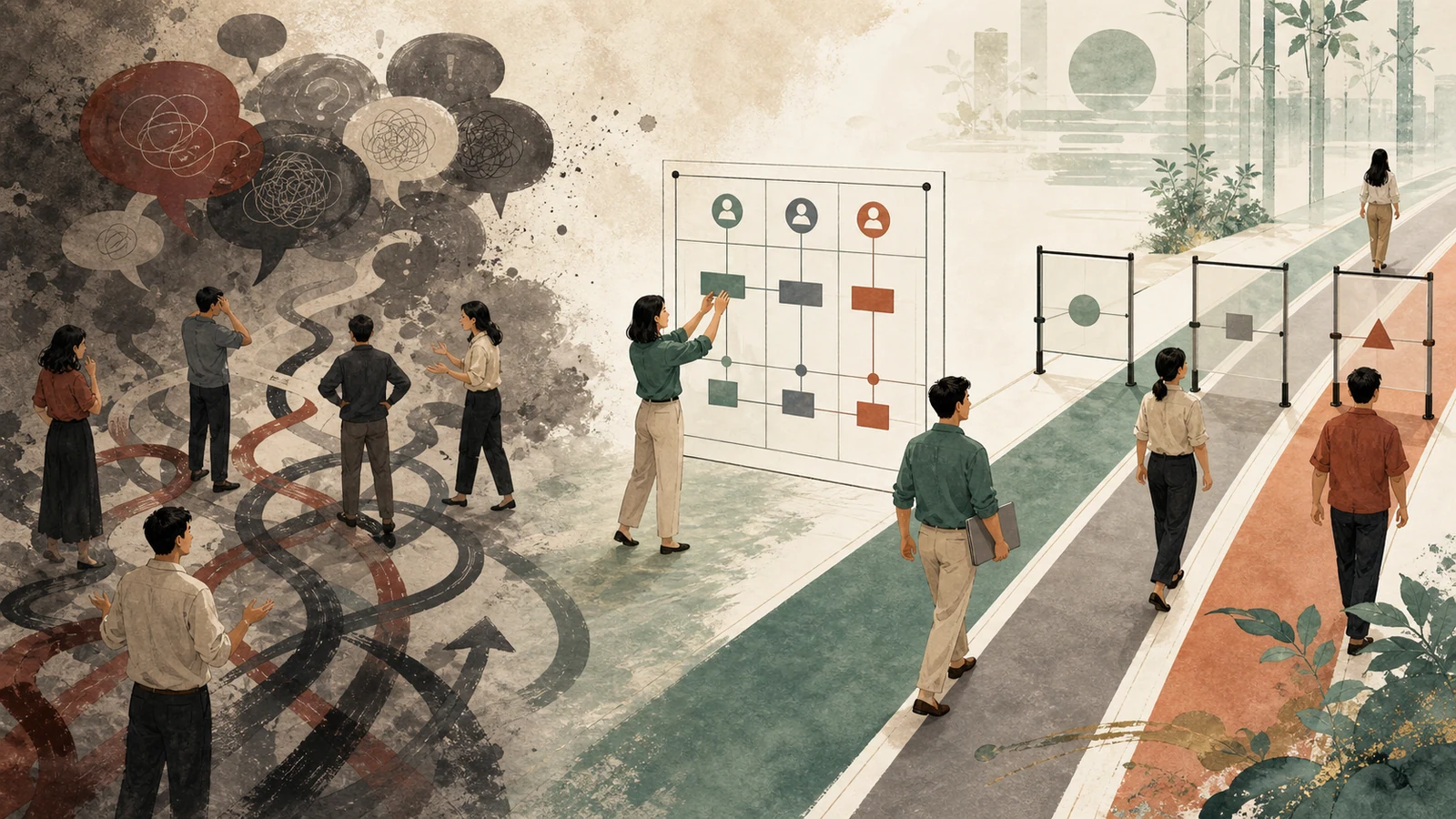
What I find useful in Cao Cao is not coldness, but the ability to see an organization as a system. The material describes his focus on merit, placing people in roles that fit their strengths, building agricultural logistics, and enforcing clear rules. In office language, this becomes a very practical question: does this work need a strong analyst, a strong executor, someone good with clients, or someone who can keep operations steady? Assigning work to whoever is familiar or currently available is an easy way to pay for rework later.
A software project gives a simple example. One person may be excellent at architecture but weak at tracking delivery details. Another may say little in meetings but see test cases and edge cases with unusual clarity. Someone may handle stakeholders well but should not be the final owner of deep technical trade-offs. Healthy rule-based management does not force everyone to become the same. It designs work so each person’s strength has a proper place, and each person’s weakness does not tilt the entire system.
The lesson about logistics is also easy to translate. In a company, logistics is not only storage or transport. It is the flow of information, documents, decisions, money, people, and responsibility. A team with weak logistics has familiar symptoms: requirements live in Notion, Slack, and someone’s memory; decisions exist only in a thread no one can find; new hires do not know which document to read first; production bugs have no clear on-call owner; sales promises scope that delivery has never seen. The problem is not always lack of effort. Sometimes the system leaks effort.

Good rules reduce arbitrariness. If the review process is clear, a reviewer does not have to feel awkward asking for changes. If promotion criteria are clear, employees do not have to guess who needs to like them. If support SLA is clear, customers do not depend on knowing someone inside the company. If meetings have owners, agendas, and decision logs, individual memory no longer has to carry operations. A mature organization is not the one with the most rules, but the one with enough right rules to reduce ambiguity for people who want to work well.
But Cao Cao also gives me a reason to be cautious. A system built on too much suspicion can create very expensive silence. When people are afraid of being blamed, they learn to say less. When every small error is treated as a moral failure, the team hides risk until risk becomes an incident. When a leader assumes bad motives too quickly, the organization may look disciplined from the outside while becoming defensive inside.
In offices, this appears in quieter forms. A dashboard that tracks too tightly may make people optimize the number instead of the outcome. A manager who repeatedly asks for screenshots of progress may think they are controlling delivery, while the person receiving the message feels untrusted. A rigid reward and punishment policy may push people away from hard work because hard work can make metrics look worse before it makes the product better. When rules lose their humanity, they do not make the organization clearer. They teach people how to survive under cover.

What I want to keep from Cao Cao is respect for systems. Some problems cannot be solved by encouragement. You cannot only tell people to try harder if handoffs are broken. You cannot ask for more ownership if decision rights are unclear. You cannot ask for responsibility if everyone has a different definition of done. In those moments, the kindest thing may not be softer words, but clearer rules.
A good workday probably needs a healthy amount of this rule-based spirit. The work is clear, the owner is clear, the standard is clear, escalation is clear, and learning from mistakes is also clear. When the system is clear enough, people spend less energy guessing one another’s intentions. And when there is less guessing, there is more strength left for real work, real support, and calmer accountability.