
A familiar incident review starts with a simple question: why did one checkout request take eight seconds? The application logs show no obvious error. One service retried twice, another waited longer than the caller's deadline, and a third returned a successful response after the user had already given up. By the time the path is drawn on a whiteboard, nobody is discussing a single bug anymore. The real problem is that the rules between services are scattered, inconsistent, and difficult to see.
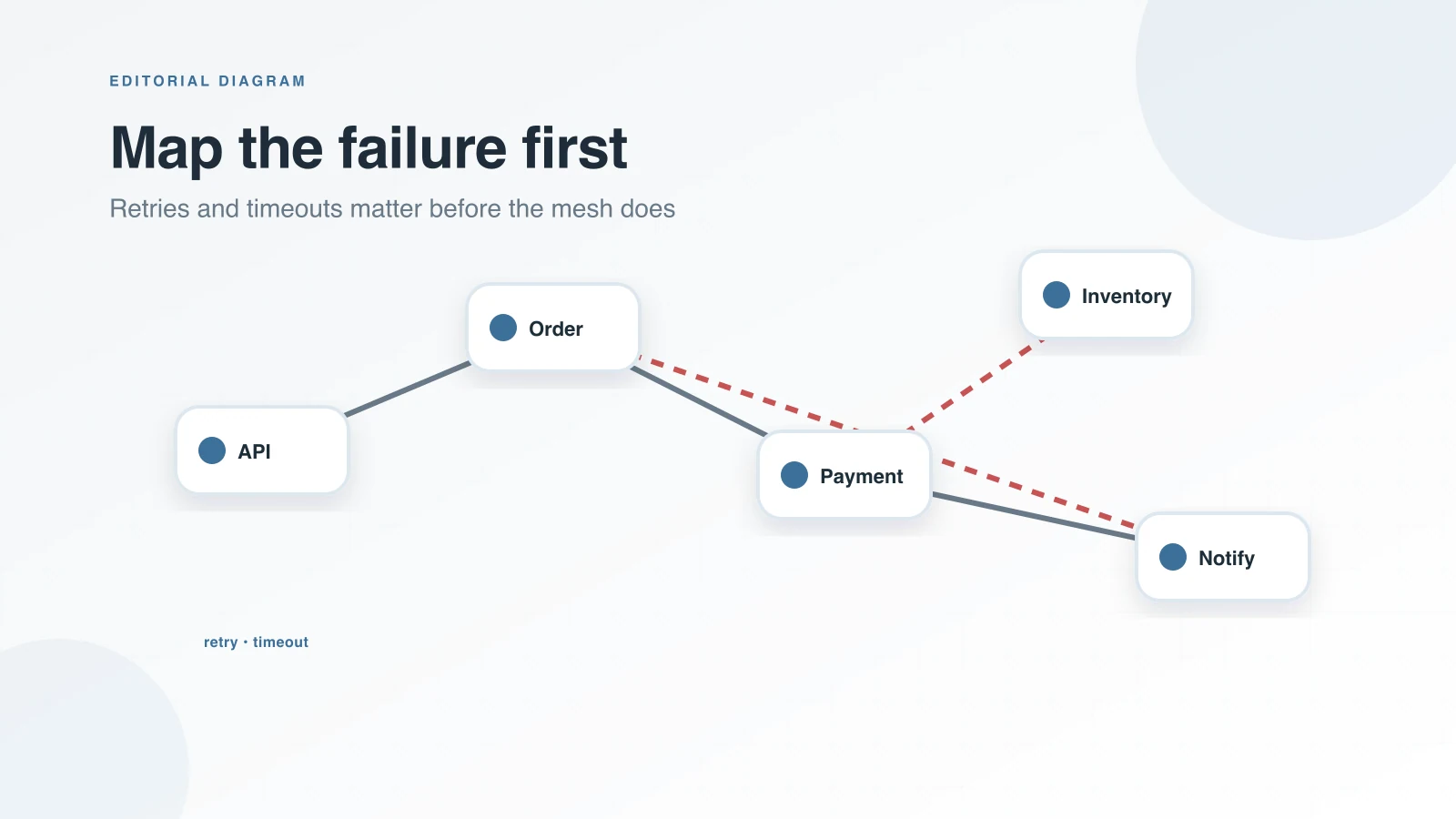
A service mesh can bring order to that narrow class of problem. Its data plane sits on the communication path, commonly through sidecar proxies, while its control plane distributes identity, routing, and policy. This can standardize mutual TLS, timeouts, retries, traffic splitting, metrics, and traces without requiring every application team to implement the same machinery in every language.
That description is appealing, but it is not yet a reason to adopt one. A mesh does not repair unclear service boundaries, unreliable application code, weak ownership, or a database shared by half the platform. It cannot decide whether a synchronous call should exist. It can reveal a tangled dependency graph with impressive precision while leaving the tangle untouched. The useful question is therefore not whether service mesh technology is capable. It is whether the failures you pay for are failures a mesh can reduce.
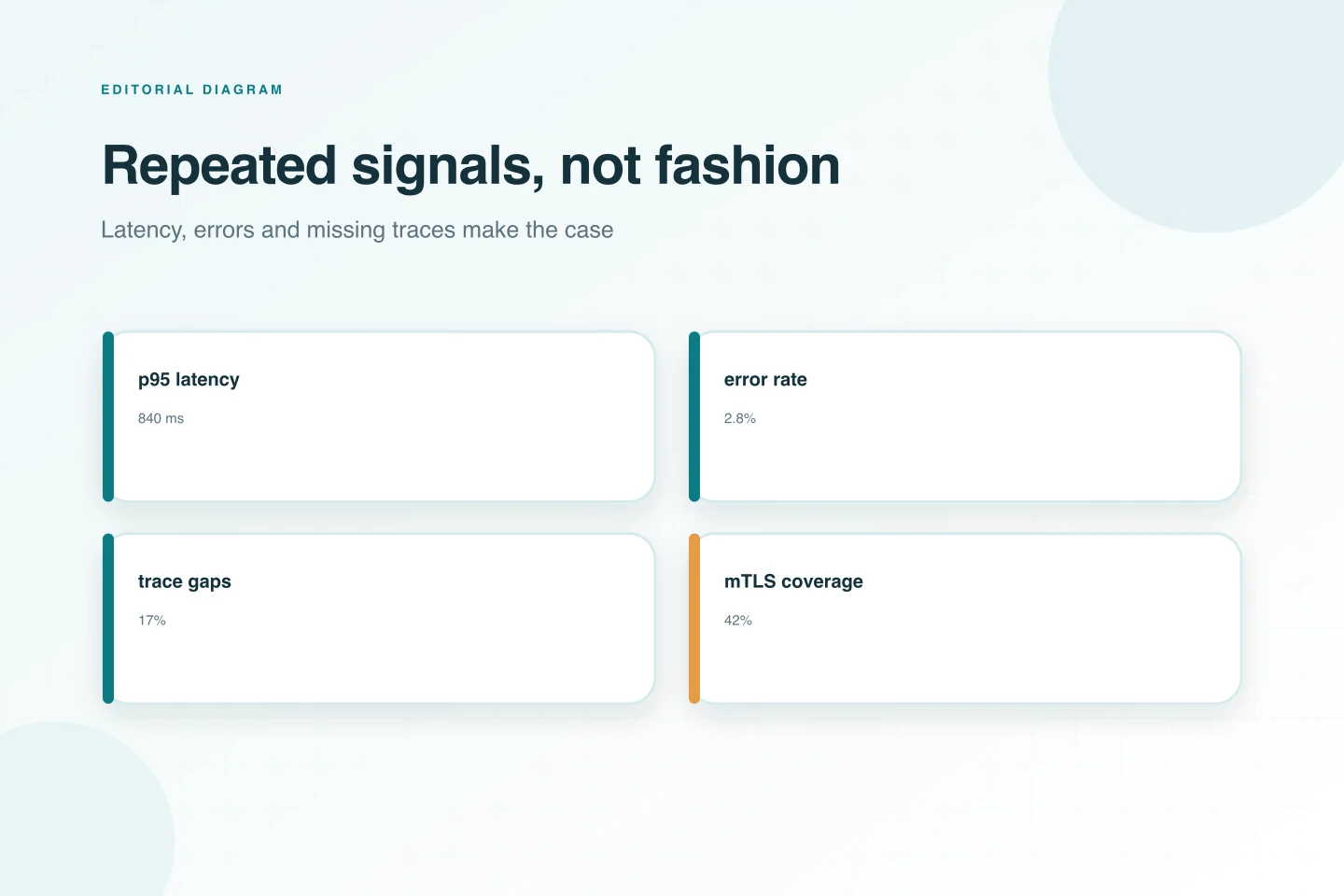
Begin with production evidence. Look at latency by hop, not only at the edge: p50, p95, and p99 tell different stories. Measure error rates, connection resets, deadline exceeded errors, and the number of downstream attempts created by one incoming request. Check how many traces are complete from entry point to final dependency. Compare the intended mTLS coverage with the traffic that is actually encrypted and authenticated. Review incidents caused by policy drift, certificate rotation, inconsistent client libraries, or a dependency path that took too long to reconstruct. The count of services matters less than the frequency and cost of these repeated failures.
The strongest case appears when several signals line up. Many teams ship services in different languages, so one shared client library cannot reliably enforce network behavior. Retry and timeout policies have drifted enough to produce outages. Security requires workload identity and mTLS across a changing service graph. On-call engineers repeatedly lose time because telemetry ends at process boundaries. A platform team already exists, can operate the control plane, and is prepared to support application teams. In that setting, a mesh can replace duplicated, uneven work with one owned capability.
There are also clear cases where a mesh is too much. A handful of services in one language can often share a well-maintained client library and common gateway policy. A modular monolith may be a better answer when boundaries are still changing. If basic logs, metrics, tracing, health checks, and ownership are missing, a mesh adds new signals before the team can use the old ones. If nobody has time to own upgrades, certificate failures, policy review, and on-call support, the platform is not removing work; it is moving work into a layer with a larger blast radius.
The extra layer brings its own failure modes. Retries in both the application and proxy can multiply load precisely when a dependency is already struggling. A generous proxy timeout cannot rescue a caller whose deadline expires earlier. Sidecars consume CPU and memory, and poor capacity planning turns infrastructure into latency. A bad routing rule can redirect thousands of requests at once. Slow configuration propagation can leave workloads following different policies. Certificate rotation can break healthy applications without a code change. If the control plane is unavailable, the team must know what the data plane will keep doing, what will become stale, and whether security policy fails open or closed.
Debugging also changes. The application may report a cancellation while the proxy records an upstream reset and the dependency logs a successful response. Engineers need a shared way to correlate those three views. Version skew between proxies and the control plane must be managed. Runbooks need to cover configuration, identity, routing, and resource pressure, not only application code. A mesh that only two specialists understand is a fragile organizational dependency, even when the software itself is highly available.
A sensible pilot starts with a baseline and one contained request path. Choose two or three services where the communication problem is already measured and the business blast radius is manageable. Record current tail latency, error rate, retry amplification, trace completeness, on-call diagnosis time, proxy resource cost, and mTLS coverage. Write down what improvement would justify the operating cost. “We installed the mesh successfully” is not a success criterion; fewer repeated failures or faster, safer diagnosis might be.
Keep application retries and proxy retries from silently overlapping. Exercise slow dependencies, connection drops, expired certificates, bad routes, and an unavailable control plane before trusting the pilot. Watch both the application and proxy view during the same test. The goal is not a flawless dashboard. It is confidence that the team can explain what happens under partial failure and can tell whether the new layer improved the outcome.
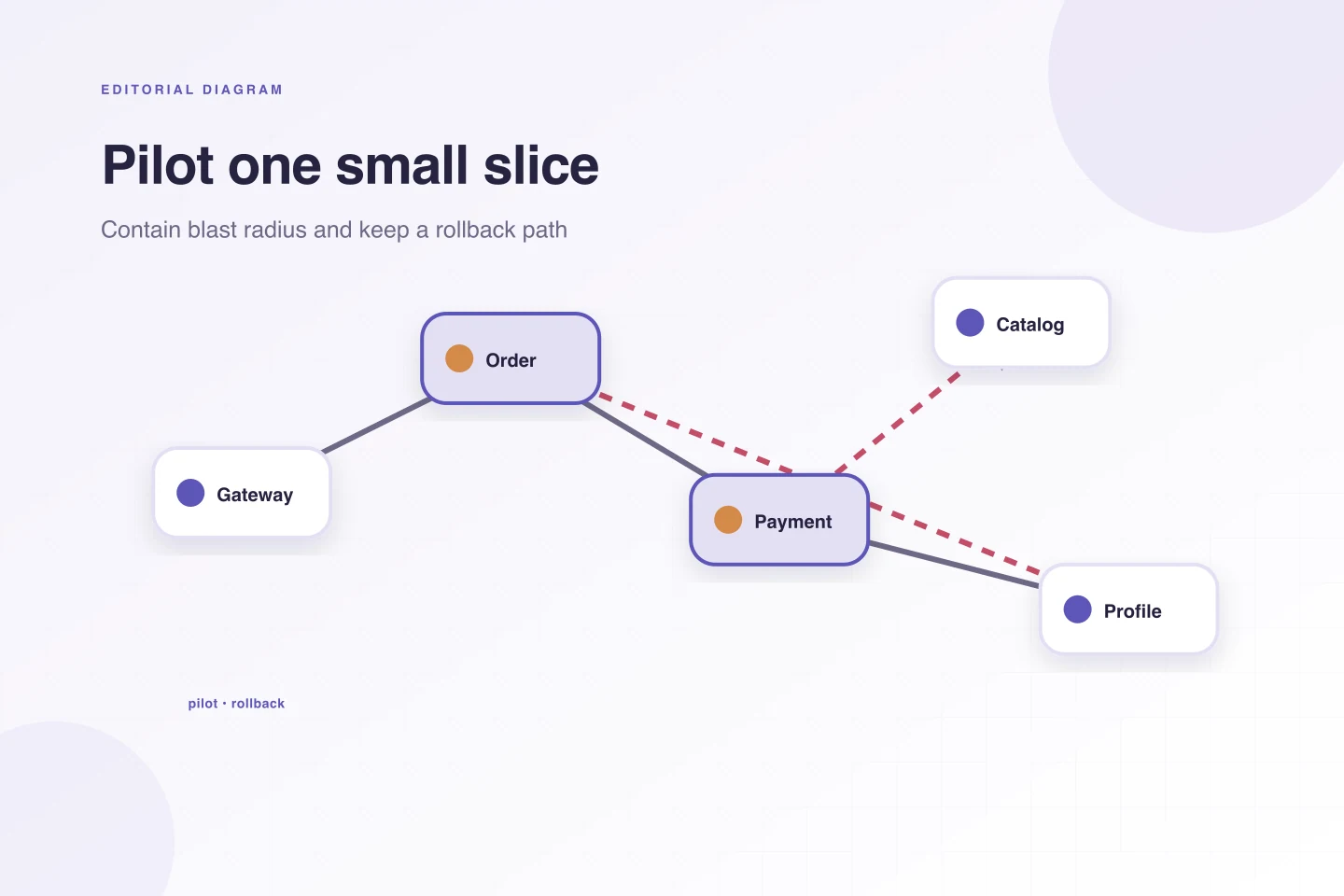
Rollback must be designed before rollout. Preserve the previous routing and security configuration, define how workloads leave or bypass the data plane, and test the redeploy or restart that change requires. Know which protections temporarily move back to the application or gateway. Avoid a rollback that removes mTLS or rate limits without an approved fallback. Set a time limit for the pilot and a stop condition for latency, error rate, resource use, or operational confusion. Reversibility is part of the architecture, not paperwork added after trouble begins.
Expand only when the pilot produces evidence worth carrying forward. A wider rollout needs an owner, an upgrade policy, compatibility testing, capacity budgets, alerts for the mesh itself, and a clear boundary between application responsibility and platform responsibility. The mesh may own transport identity and traffic policy; application teams still own business contracts, data integrity, idempotency, and whether a call should be synchronous at all.
The practical answer is deliberately unexciting. Adopt a service mesh when recurring service-to-service failures are measurable, simpler controls have stopped scaling, and a team is ready to own the new failure domain. Otherwise, standardize timeouts, retries, tracing, identity, and service ownership with the tools already in place. The right decision is tied to a named failure and a measurable improvement. Without both, the extra layer is only another system to operate.