
The team understood the decision on Friday. By Monday, the context had already started to thin out. The person who argued for the simpler design remembered the incident risk. The person who preferred the more flexible design remembered the future roadmap. A new teammate joining two months later would only see the final shape in code and wonder why it looked a little unusual.
Architecture decisions often fail as memory before they fail as design. The code may still work. The tests may still pass. But the reason behind the shape becomes hard to recover. When that happens, future changes become slower because every refactor starts with archaeology. People ask whether a boundary was intentional, whether a compromise is still needed, or whether a strange dependency is a bug wearing the clothes of history.
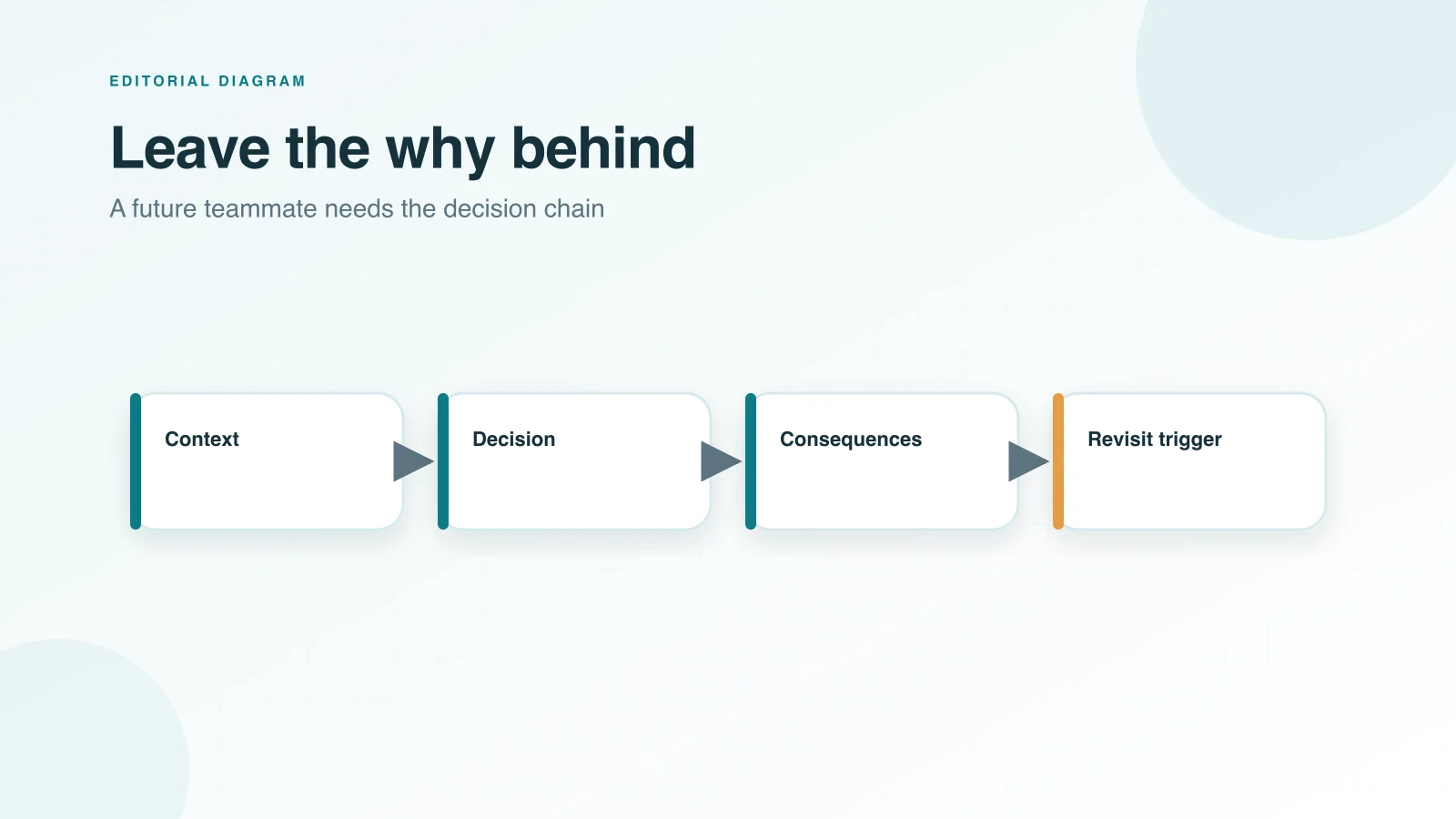
A decision note does not need to be grand. It can be a short ADR, a design comment in a repo, or a small section in a spec. The useful parts are stable: what question was being answered, which option was chosen, which options were rejected, why the team chose this path, what debt was accepted, and what signal should trigger a revisit.
The rejected options matter more than teams expect. Without them, the future reader may repeat the same debate with less context. A note that says why the team avoided a shared database, delayed a queue, or kept a module inside the monolith can save hours of confident rediscovery. It also makes the team more honest about uncertainty. The note can say: this was the best answer for our size, traffic, deadline, and operational skill at the time.
Good architecture memory protects people, not just code. It lets a newcomer ask better questions without feeling like they are challenging someone personally. It lets a maintainer change a decision without pretending the original team was careless. It gives reviewers a shared artifact instead of relying on whoever speaks most confidently in the meeting.
The strongest decision notes are written close to the work. If they wait until the project is finished, they become polished history. If they are written while the trade-off is fresh, they capture the small facts that rarely survive: the customer deadline, the incident that made the team cautious, the migration path that was too expensive, the test gap that made a shortcut unacceptable.
I like to end these notes with a revisit trigger. If traffic grows beyond a threshold, revisit. If two teams start changing the module independently, revisit. If the integration adds one more external provider, revisit. This keeps the decision alive without making it fragile. A decision should not be permanent because it was documented. It should be understandable enough to change safely.
Future teammates do not need every thought we had. They need enough context to avoid treating the codebase like a mystery. A small architecture decision note can turn a strange shape from confusion into continuity. That is often the difference between maintaining a system and slowly losing trust in it.