
The demo worked beautifully. A prompt went in, a polished answer came out, and the room immediately imagined the product around it. The hard part started later, when someone asked what should happen when the input is vague, the source is missing, the model is slow, the answer is wrong, or the same user tries the flow three times with slightly different wording.
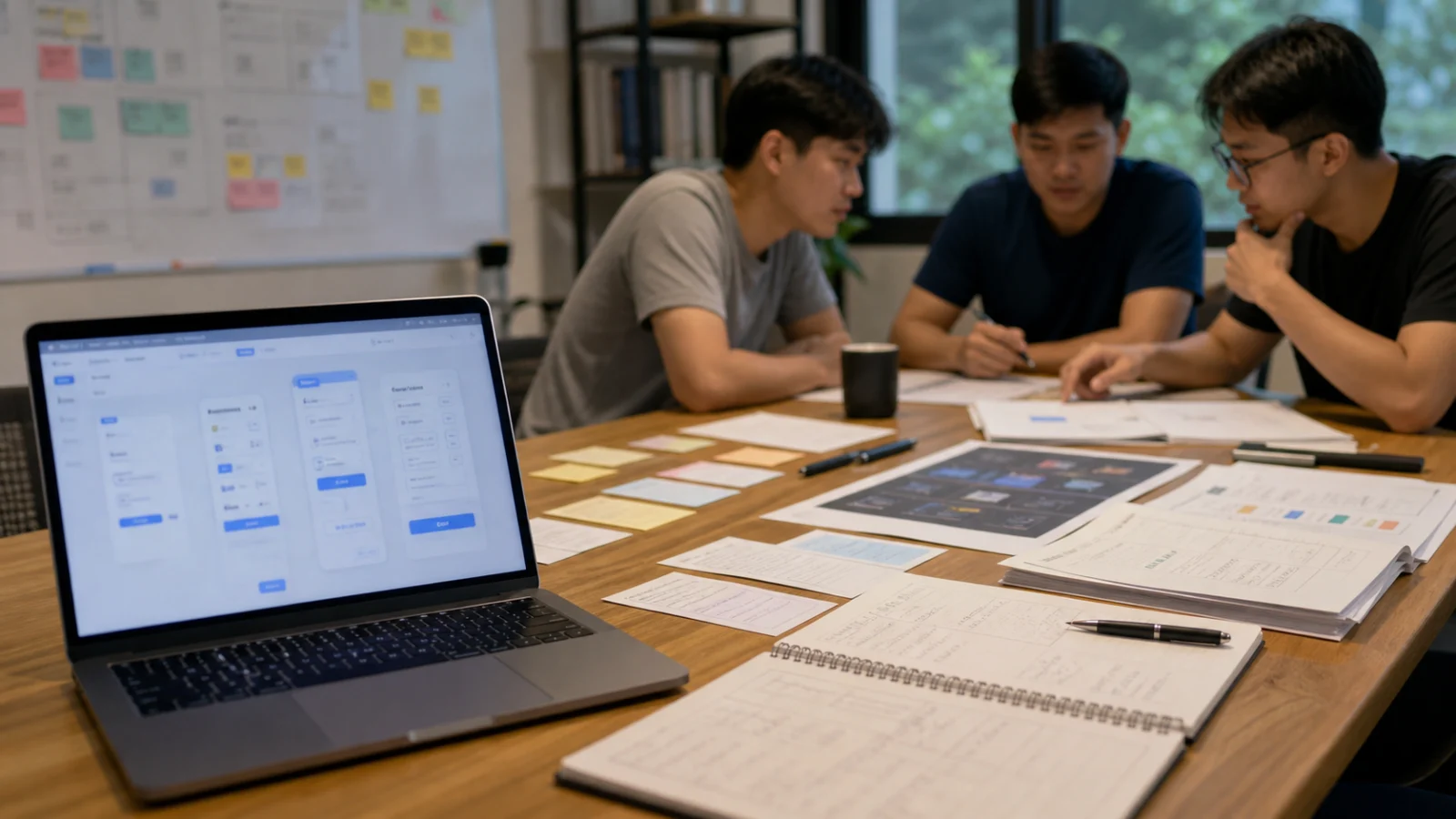
AI prototypes are powerful because they make possibility visible quickly. That is their job. A small demo can help a team understand the interaction, the value, and the emotional shape of the experience. But a demo is usually optimized for the happy path. It is a conversation starter, not a contract.
Production behavior is different. It asks for boundaries. What input is supported? What is out of scope? When does the system refuse? When does it ask for clarification? What evidence is shown? What is logged? What is never logged? What happens if the provider is down, the context is stale, or the user expects certainty the product cannot honestly provide?
The first gap is evaluation. A demo often proves a few examples. Production needs a small but representative set of cases: easy, ambiguous, adversarial, empty, long, multilingual, and domain-specific. The goal is not to guarantee perfection. The goal is to know where the system behaves acceptably, where it fails clearly, and where humans must stay in the loop.
The second gap is recovery. A product can survive a wrong answer more easily when it has a graceful next step: show sources, mark uncertainty, ask a narrower question, route to a human, retry safely, or save a draft instead of taking action. The more the AI can affect money, privacy, reputation, or customer trust, the more explicit the recovery path must be.
The third gap is observability. Teams need to know not only whether the request returned 200, but whether users accepted the answer, edited it, retried it, abandoned the flow, or reported a problem. Without this feedback, the product team is steering by demo memory. AI behavior changes with inputs, context, and model updates. That makes monitoring part of the feature, not an afterthought.
There is also a language gap between product excitement and engineering responsibility. A prototype says, look what is possible. A production spec says, this is what we promise, this is what we do not promise, and this is how we will know when the promise is breaking. Both are useful. Trouble starts when the team treats the first sentence as if it already contains the second.
I like keeping a simple checklist beside every AI demo: supported inputs, refusal rules, evidence display, eval cases, fallback behavior, privacy boundaries, cost limit, latency target, and owner for review. The checklist slows the room down just enough to turn a clever moment into a dependable behavior.
A prototype can earn attention. Production earns trust. The bridge between them is not more impressive output. It is the quiet work of naming failure modes, testing ordinary cases, and deciding what the product should do when the model is fluent but the situation is not simple.