
The office was quiet after lunch, and the AI answer looked almost too helpful. It explained the production symptom, named the likely cause, suggested a patch, and described the trade-off in a calm tone. The paragraph had the shape of senior judgment. For a moment, it felt like the problem had become smaller.
That feeling is useful, but it is also the danger. Fluent language can feel like evidence because it reduces our uncertainty at the exact moment we want uncertainty to end. A confident answer gives the mind something to hold. In a busy team, that can be enough to move from reading to acting before anyone asks the slower question: what outside the model proves this is true?
The cost of trusting a fluent AI answer is not always a dramatic outage. Sometimes it is a wasted afternoon fixing the wrong layer. Sometimes it is a subtle bug merged because the explanation sounded plausible. Sometimes it is a product decision shaped by a summary that skipped the uncomfortable customer examples. The answer may not be malicious or useless. It may simply be unverified in a context where being wrong has a cost.
AI is especially persuasive when it uses the language of our field. It can say idempotency, rollback, eventual consistency, security boundary, or user trust in the right rhythm. Those words are helpful when they guide thinking. They become risky when they make us feel that thinking has already happened. The model can produce the surface of expertise without carrying the responsibility of expertise.
A fluent answer lowers friction. It does not lower responsibility. The smoother the answer sounds, the more useful it is to ask what claim it is making and how that claim can be checked.
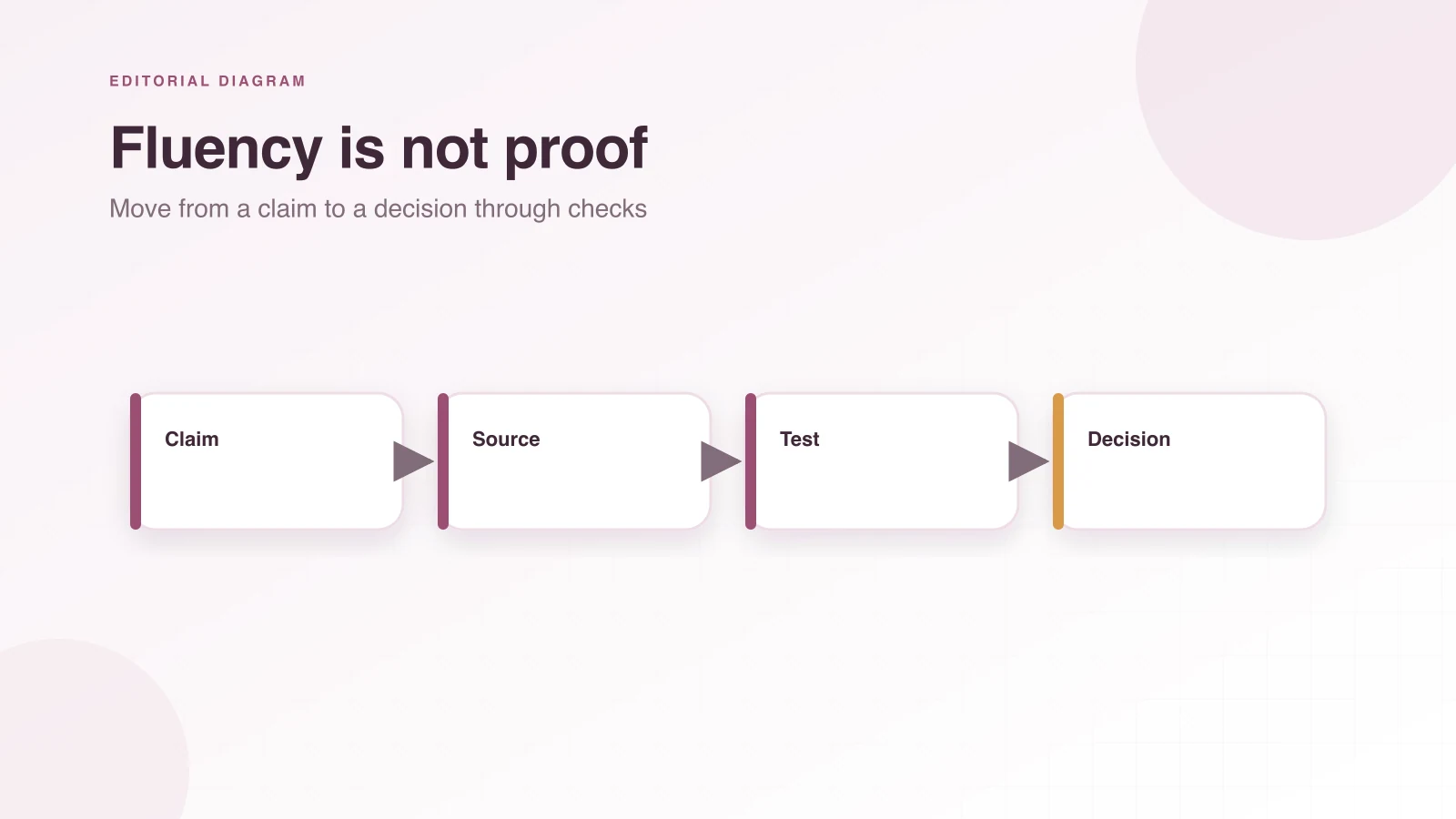
A practical response begins by separating draft from decision. Let AI draft the hypothesis, the checklist, the comparison table, or the possible fix. Then move the important claims into the world. If the answer names a root cause, reproduce the symptom and inspect the logs. If it suggests an index, check the query plan and write cost. If it summarizes a policy, open the source. If it proposes a code change, run the tests and read the edge cases. The model can help you design the check, but it should not be the only judge of its own answer.
The size of the check should match the risk. A grammar rewrite may need only a careful read. A deployment recommendation needs more. A security change needs evidence, review, and probably a second pair of eyes. A customer-facing AI feature needs evaluation examples, refusal behavior, and source visibility. Verification is not one ritual. It is proportionate care.
Teams can make this easier by changing how AI-assisted work is handed off. A pull request can include a small note: which parts were AI-assisted, which assumptions were checked, which tests were run, and which areas still deserve reviewer attention. A product document can separate AI-generated options from validated customer evidence. A support workflow can show the source paragraph beside the suggested reply. These traces keep responsibility shared instead of hidden inside a private chat.
There is also a learning benefit. When we verify an AI answer, we do not only reduce risk. We turn borrowed confidence into internal understanding. The failed hypothesis teaches us where the system boundary really is. The passing test teaches us which assumption mattered. The source check teaches us which document is stale. Without that step, AI can make us faster while quietly making our mental model thinner.
The healthier habit is not suspicion for its own sake. It is ordinary engineering discipline applied to a new kind of draft. We can appreciate the speed, use the structure, and still keep ownership. A fluent answer is often a good beginning. It is rarely the final proof.
The next time an AI answer feels immediately right, pause for one small question: what would be costly if this is wrong? The answer to that question usually tells you what kind of verification the work deserves. If you have a recent example where an AI answer helped, or where it sounded better than it was, comparing those two moments is where the useful learning starts.